

Flying a Drone in Winter: Battery, Snow, Fog & Rules
Newsletter
Latest articles

Flying a drone in winter works well if you have three things under control: warm, fully charged batteries, dry weather with little wind, and the rules for short, dark days. Cold slows down the chemistry in the battery, the flight time becomes shorter, and fog or early darkness make visual contact more difficult. In return, you get images that don't exist in summer: hoarfrost, snow-covered forests, a low-hanging sun, and clear visibility. In this guide, you will learn how to prepare yourself and your drone for the cold season.
Contents
- Battery in the cold: Why flight time decreases
- Weather in winter: Snow, fog, wind
- Rules in winter: Darkness, visual contact, protected areas
- Winter photos with the drone
- Conclusion
- FAQs
The most important things in brief
- Battery temperature: According to ÖAMTC, drone batteries work best from about 20 °C. Below 0 °C, the drone should stay on the ground.
- Warm-up: After takeoff, hover for 30 to 60 seconds so that the battery and motors reach operating temperature.
- Weather: Strong wind, rain, and snowfall are exclusion criteria.
- Darkness: In Germany, night flights in the open category are possible without special permission, but the drone needs a green flashing light.
- Visual contact: Always applies, even in fog and at dusk. Maximum 120 m above ground level.
- Protected areas: Recreational flights over nature reserves and national parks are generally not allowed in Germany.
Battery in the cold: Why flight time decreases
The battery is your most important topic in winter. Most hobby drones fly with lithium-polymer batteries (LiPo). In the cold, the chemical processes in the battery run slower. It can then deliver less power, and the flight time decreases. According to ÖAMTC, the optimal battery temperature is 20 °C or above. Many drones show you the battery temperature in the app or on the remote control. Take a look before takeoff.
Properly pre-warming batteries
Charge your batteries fully at home and transport them warm: in the inner pocket of your jacket, in a padded bag, or with a battery warmer. Do not leave them in the car overnight. Insert the battery only shortly before takeoff so that it spends as little time as possible in the cold air.
The first seconds after takeoff
ÖAMTC recommends hovering the drone at a low altitude for 30 to 60 seconds after takeoff. This allows the battery and motors to reach operating temperature, and you will notice early on if the drone behaves sluggishly or unusually. Only then do you climb higher.
Realistically planning flight time
In winter, expect noticeably less flight time than on the data sheet. Plan shorter flights, land earlier than usual, and keep a constant eye on the battery indicator. In addition, according to ÖAMTC: The higher you fly, the faster the propellers must spin, and the faster the battery empties. One or two suitable spare batteries from drone accessories make a winter day significantly more relaxed.
- Charge batteries fully at home and pack them warm.
- Check the battery temperature in the app before you start.
- After takeoff, hover low for 30 to 60 seconds.
- Plan short flights and land with a generous reserve.
- Immediately store the used battery warm again.
Weather in winter: Snow, fog, wind
In addition to the cold, winter weather presents its own challenges. Check the forecast for wind and precipitation before every trip. ÖAMTC puts it clearly:
"In strong wind, rain, or snowfall, flights are an absolute no-go."
Snow on the ground: Takeoff and landing
If you take off directly from the snow, the rotors kick up snow, which can get into the motors, ventilation slots, or camera. Therefore, use a landing pad or another solid, dry surface. In case of emergency, a plastic box or the transport bag will also do. Keep the propellers and camera lens dry and wipe off moisture after the flight.
Fog and high fog
Fog is common in late autumn and winter, and it is treacherous. The problem is less the moisture than visual contact: In the open category, you must be able to see your drone directly during the entire flight. If it disappears in the fog, the flight is no longer compliant with the rules, even if the live image on the display still works. So, in fog, only fly as far and as high as you can safely recognize the drone with your own eyes.
Wind and gusts
Winter wind is often cold and gusty, especially on hills, at lakes, and in the mountains. Small and light drones have more to deal with. Strong headwind additionally costs battery, especially on the way back. Therefore, fly against the wind first and let yourself be carried by the wind on the way home.
The following overview helps you assess typical winter conditions:
| Condition | Risk | What you do | Fly? |
|---|---|---|---|
| Cold, dry, above 0 °C | Shorter flight time | Pre-warm batteries, hover briefly, land earlier | Yes, with caution |
| Below 0 °C | Battery delivers too little power | According to ÖAMTC, stay on the ground | No |
| Snow on the ground | Kicked-up snow gets into the device | Use a landing pad or solid surface | Yes, with pad |
| Snowfall, rain | Moisture, poor visibility | Postpone flight | No |
| Fog | Visual contact is lost | Only stay within visual range, otherwise do not start | Only within visual range |
| Strong wind, gusts | Drift, high battery consumption | Postpone flight | No |
Rules in winter: Darkness, visual contact, protected areas
The drone rules are the same in winter as in summer. Some points play a bigger role in the cold season, however, because the days are short and many people are out and about in winter sports areas. A general overview of allowed flight locations can be found in our guide Where can you fly a drone?
Flying at dusk and at night
In winter it gets dark early, and quickly you are out and about with the drone in the dusk. The Luftfahrt-Bundesamt (LBA) makes it clear: Night flights are not excluded in Germany and do not need special permission. The drone must be equipped with a green flashing light when operating at night. And visual contact applies at night just as much as during the day. In Switzerland, flights within visual range are allowed at night according to the Bundesamt für Zivilluftfahrt (BAZL), if the drone has position lights. So check beforehand if your drone comes with the appropriate lighting. If not, plan your flights so that you are back on the ground before darkness.
Visual contact and maximum height
In the open category, according to the LBA, a maximum flight height of 120 m above ground level and immediate visual contact during the entire flight applies. The BAZL calls the same maximum limit for Switzerland. In the mountains, the height above ground level is difficult to assess, which the ÖAMTC also points out: If you fly down a slope, the distance to the ground increases quickly. Therefore, fly defensively in the terrain and keep an eye on the altitude display.
Nature reserves and wildlife
In winter, many wild animals are particularly sensitive to disturbances. In Germany, § 21h Abs. 3 Nr. 6 of the Luftverkehrs-Ordnung (LuftVO) regulates operation over nature reserves and national parks. Without the approval of the responsible nature conservation authority or a deviating state law regulation, operation for sports or recreational purposes is not permitted there. Where exactly these areas are located, the map on dipul.de, which the LBA recommends checking before every flight, shows you. In Austria, you can find the corresponding information on dronespace.at, the drone platform of the Austro Control.
Ski resorts and slopes
Snow-covered slopes look spectacular from above, but are not a good place for hobby flights. The ÖAMTC advises against flying over or near ski slopes: There are many people out and about, lift masts and cables are difficult to see, and rescue helicopters can appear at any time. If you yourself are on skis, you can hardly concentrate on flying. Better avoid quiet, open areas away from the operation and clarify beforehand with mountain railways or municipalities what is allowed.
Winter photos with the drone
When the technology and rules are right, comes the beautiful part: winter landscapes from the air. The sun is low, the light is soft, and on clear days, the view reaches far. More basics on image composition can be found in our guide Taking photos with a drone.
Exposure in the snow
Snow reflects a lot of light. The automatic exposure of your camera tries to bring the image to a medium gray, and snow then quickly looks gray and flat. Set the exposure compensation slightly into the plus and check the result on the display. At the same time, make sure that bright areas do not completely burn out. If your drone displays a histogram, that is a big help.
Motifs that work in winter
- Traces in the snow: Paths, cross-country trails, or tire tracks create strong graphic lines from the top view.
- Contrasts: Dark trees, rivers, or roads stand out clearly against a white background.
- Hoarfrost and fog banks: Often spectacular in the mornings over valleys, as long as you keep the drone in view.
- Golden hour: Because the sun sets early, you catch warm, deep light already in the afternoon – without getting up early.
Avoid condensation
If you come from the cold into a warm room, moisture can condense on and in the drone. Therefore, let the drone slowly come to room temperature in the closed transport bag before you unpack it. Charge batteries only when they are no longer cold.
Which drone is suitable for winter trips?
For winter tours, functions are helpful that take work off your hands when your fingers are cold and the conditions change quickly. The Piecarté P15 with GPS and return function, for example, comes with an automatic return function, GPS, and a remote control with its own screen, so that you do not have to handle the smartphone additionally. The stated flight time of approx. 30 minutes you will not exhaust in winter, so plan with a reserve here too. Because the P15 has a camera, you must register as an operator. This applies according to the LBA to all drones from 250 g takeoff mass or with a sensor that can collect personal data, such as a camera.
Conclusion
Flying a drone in winter is worth it if you plan a little more than in summer. The battery decides how long and how safe your flight will be. The weather decides whether you even start. And the short days demand that you keep darkness, visual contact, and protected areas in view.
Your next steps:
- Check if your drone displays the battery temperature and if it is illuminated for flights in the darkness.
- Get a landing pad and a second battery that you transport warm.
- Look at your desired spot beforehand on dipul.de.
- Practice takeoff, hovering, and landing on a still, dry day. Tips for this can be found in Learning to fly a drone: 10 tips for beginners.
FAQs
Can you fly a drone at minus degrees?
ÖAMTC recommends leaving the drone on the ground below 0 °C, because the battery then delivers too little power. At temperatures just above zero, you can fly if you pre-warm the batteries and plan shorter flights. In addition, observe the temperature specifications in the manual of your drone.
Why is the drone battery so quickly empty in winter?
Cold slows down the chemical processes in the battery. It can deliver less power, and the flight time decreases. Wind and higher flight altitudes increase the consumption additionally.
Can I fly my drone in the dark?
In Germany yes, provided the drone is equipped with a green flashing light at night and you can see it directly at all times. You do not need a special permission for this according to the LBA. In Switzerland, the BAZL requires position lights for night flights.
Can I fly in snow?
Lying snow is not a problem if you start from a solid surface like a landing pad. In snowfall, you should not fly, because moisture can get into the device and the visibility becomes worse.
Can I fly over a snow-covered nature reserve?
In Germany, recreational flights over nature reserves and national parks are generally not permitted according to § 21h LuftVO, unless the responsible nature conservation authority agrees or state law regulates it differently. Check your spot beforehand on dipul.de.
Status: October 2026. All information without guarantee; the information of the responsible authorities is decisive.

Drones may only be flown in residential areas under strict conditions. The most important rules are:
- Drones weighing over 250g or equipped with a camera require the permission of the landowner.
- Maximum permitted flight altitude: 120 meters.
- Drones must always remain within visual range.
- Registration with the Federal Aviation Office (LBA) is mandatory for drones weighing over 250 g or equipped with a camera.
- Liability insurance is mandatory for all drone flights.
Violations can result in fines of up to €50,000 or even imprisonment. Those who want to fly safely should comply with all regulations and avoid sensitive areas such as crowds or no-fly zones.
Tip: Check the DIPUL map or a drone app before every flight to avoid no-fly zones.
Drone laws 2025: All rules for drone pilots for DJI Mini 4 Pro, DJI Mini 4K & Neo etc.
sbb-itb-d7de319
Drone laws in Germany
The legal framework for drone flights in Germany is based on a two-tier system: EU Regulation 2019/947 of the European Union Aviation Safety Agency (EASA) provides the general framework, while the German Air Traffic Regulations (LuftVO), in particular Section 21h, stipulate additional national rules. The following sections explain the EU-wide provisions and the specific German regulations in more detail.
EU Drone Regulation
The EU regulation categorizes drone flights into three risk categories: Open (low risk, no permit required), Specific (medium risk, permit required), and Certified (high risk, certification required). For residential areas, the Open category is particularly relevant, which is further divided into three subcategories:
- Category A1: Drones weighing less than 250 g (C0) or less than 900 g (C1) are permitted to fly over populated areas. Flying over uninvolved persons must be avoided. Intentionally flying over crowds of people is prohibited.
- Category A2: Drones up to 4 kg (C2) may be operated in residential areas with a minimum horizontal distance of 30 m to people. In slow flight mode, a distance of 5 m is sufficient. An A2 remote pilot certificate is required.
- Category A3: For drones up to 25 kg (C3/C4), a minimum distance of 150 m to residential, commercial or industrial areas applies.
Additionally, the Open category has a maximum flight altitude of 120 meters above ground level. Drones weighing over 250 grams or equipped with a camera must be registered with the German Federal Aviation Office (LBA). Registration costs are €20 for private individuals and €50 for legal entities. The electronic operator ID (e-ID) must be visibly displayed on the drone. Since January 1, 2024, drones in classes C1, C2, and C3 must also transmit a remote ID.
German national laws and restrictions
Germany supplements EU regulations with stricter national rules, particularly regarding the protection of privacy and residential areas. According to Section 21h of the German Air Traffic Regulations (LuftVO), drones weighing over 250g or equipped with cameras may not fly over residential properties without explicit permission. This regulation goes beyond EU requirements and protects the rights of property owners.
Another important regulation is the general insurance requirement for drone flights. According to the German Air Traffic Act (LuftVG §37), liability insurance is mandatory, regardless of the drone's weight or purpose. Annual premiums for hobby pilots typically range from €30 to €100.
The minimum age for independent drone flights is 16. Furthermore, safety distances of approximately 100 meters must be maintained from federal highways, railway lines, power plants, hospitals, and nature reserves. These additional regulations underscore Germany's efforts to ensure the safe and responsible operation of drones.
Requirements for drone flights in residential areas
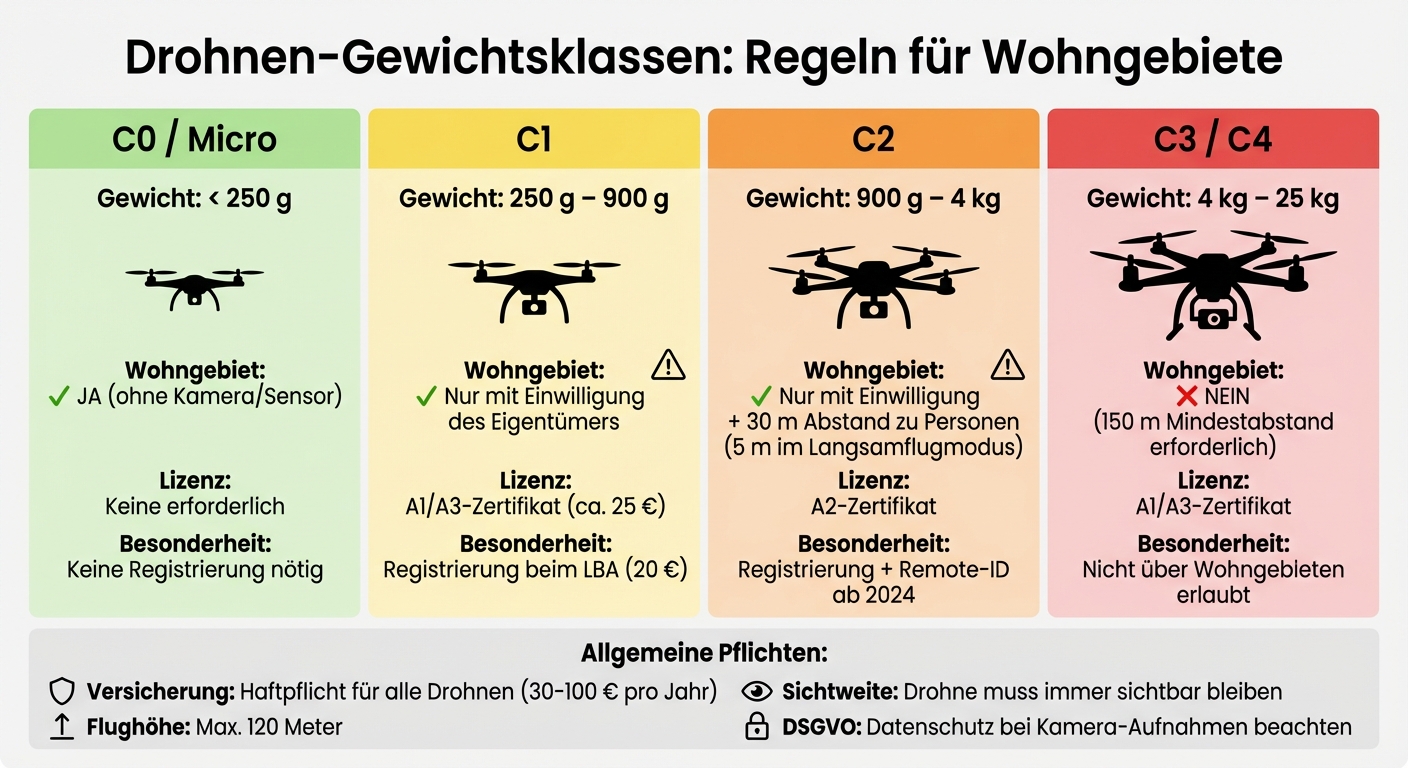
Drone weight classes and regulations for residential areas in Germany
Drone weight classes and permits
The weight of a drone plays a crucial role when it comes to flights over residential areas. Drones under 250g without a camera or sensors are generally permitted to fly over residential properties without major restrictions. However, as soon as a camera is installed or the weight exceeds 250g, stricter regulations apply.
For drones weighing between 250g and 900g (Class C1), the landowner's permission is required. Pilots must also present the EU A1/A3 competency certificate, which can be purchased online for approximately €25. Even stricter requirements apply to drones up to 4kg (Class C2): a horizontal distance of at least 30 meters to uninvolved persons is mandatory, which can be reduced to 5 meters in slow-flight mode. An A2 remote pilot certificate is also required.
| Drone class | Weight | Residential area permitted? | Required license |
|---|---|---|---|
| C0 / Micro | < 250 g |
Yes (without camera/sensor) |
No |
| C1 | 250 g – 900 g | Only with consent | A1/A3 certificate |
| C2 | 900 g – 4 kg | Only with consent + 30 m distance | A2 certificate |
| C3 / C4 | 4 kg – 25 kg | No (150 m distance required) | A1/A3 certificate |
These regulations are essential to making drone flights in residential areas legal and safe.
Consent and data protection rules
Drones with cameras that exceed the aforementioned weight classes are prohibited from flying over residential properties without the express consent of the owner or resident. This rule protects privacy and the right to informational self-determination. As technology expert Mateusz Kaczmarek explains:
"It is illegal to fly over residential private property with a camera-equipped drone >0.25kg without the owner's consent."
Additionally, the GDPR applies to drone footage. If people, license plates, or private areas are recognizably filmed, a legal basis for data processing must exist. Alternatively, the recordings must be anonymized before publication. Secretly recording private conversations with drones is a criminal offense and constitutes a violation of the regulations on acoustic surveillance.
Registration, insurance and licenses
In addition to weight and consent requirements, drone operators have further obligations. In Germany, liability insurance is mandatory for all drones, regardless of weight. The cost for hobby pilots ranges from €30 to €100 per year. Operator registration with the Federal Aviation Office (LBA) is also required. The resulting e-ID must be permanently and clearly affixed to the drone.
Since January 1, 2024, a new regulation has been in effect: drones in classes C1, C2, and C3 must transmit a remote ID so that authorities can identify the operator during flight. These measures, combined with the weight class regulations, help to ensure safety and privacy in residential areas.
Fines and penalties for violations
Common violations and fine amounts
Drone flights that violate regulations can be very expensive. Serious offenses can result in fines of up to €50,000. If you fly without the necessary EU certification (A1/A3 or A2), you face fines of up to €1,000. Failure to have the required liability insurance can cost up to €5,000. Flying over crowds without permission is particularly risky – fines of up to €5,000 are also possible. And flying in no-fly zones such as airports, nature reserves, or industrial sites is especially dangerous, with fines of up to €50,000.
In addition to fines, serious violations can also lead to criminal prosecution. Endangering air traffic is punishable under Section 315 of the German Criminal Code (StGB) by imprisonment for six months to ten years. Unauthorized entry into restricted airspace (ED-R) is also a criminal offense. Data protection violations, such as secretly filming people or property without consent, can be punished with up to two years' imprisonment under Section 201a of the German Criminal Code (StGB). GDPR violations could theoretically even result in fines of up to €20,000,000.
| Type of offense | Legal basis | Maximum penalty |
|---|---|---|
| Flight into a no-fly zone | Air Regulations / EU 2019/947 | €50,000 fine |
| Missing drone insurance | Air Traffic Act | €5,000 fine |
| Missing license (A1/A3 or A2) | Air Regulations | €1,000 fine |
| Missing operator registration | Air Regulations | €500 fine |
| Flight over crowds of people | Air Regulations | €5,000 fine |
| Data protection breach (recordings) | Section 201a of the German Criminal Code | 2 years imprisonment or a fine |
| Dangerous air traffic disruption | Section 315 of the German Criminal Code | 6 months to 10 years imprisonment |
In particularly serious cases, the police or the Federal Aviation Office can confiscate your drone directly. Those who follow the regulations will avoid this trouble – and protect others.
This is how you stay compliant with the rules.
Adhering to the rules is not only important to avoid fines, but also ensures greater safety. Before taking off, you should always check the geofences. Helpful tools for this are the DIPUL map (Digital Platform for Unmanned Aviation) or the Droniq app. These show you current no-fly zones and temporary restrictions (NOTAMs). You should also maintain a distance of at least 100 meters from sensitive areas such as highways, railway lines, hospitals, or power plants.
Don't forget to have the necessary documents with you on every flight: the EU Certificate of Competence (A1/A3 or A2), the operator registration (e-ID), and proof of insurance. It's also important that the e-ID is clearly visible and permanently attached to the drone. Your liability insurance must specifically cover drone flights.
If you fly over residential areas, you need the explicit permission of the property owner – at least if your drone weighs more than 250g or has a camera. Also, adhere to the maximum permitted flight altitude of 120 meters and ensure that the drone always remains within your line of sight. A flashing green light is required for night flights.
What should I do if a drone flies over my property?
Rights of landowners
If a drone flies over your property without permission, you have rights that protect you. The airspace above your property, up to a certain altitude, belongs to you. German law, in combination with the GDPR, protects you from unauthorized aerial photography. Specifically, drones with cameras and weighing more than 0.25 kg are not allowed to fly over your residential property without your explicit consent (§21h LuftVO).
Drone footage showing private spaces such as windows or fenced gardens violates Section 201a of the German Criminal Code (StGB). Images in which you or your license plate are recognizable also fall under the protection of the GDPR. In these cases, the drone pilot must have a legal basis for taking the footage.
Steps to take in case of unauthorized drone flights
If you notice a drone flying over your property, it's important to remain calm and act thoughtfully. If the pilot is nearby, speak to them. Often, they are unaware that they are breaking rules or infringing on your privacy. Politely ask them to end the flight and, if necessary, delete any recordings.
Additionally, you should document the location, time, and flight behavior of the drone. This information can be helpful if legal action is taken. You can use the DIPUL map to check no-fly zones.
If the drone is flying dangerously or you feel harassed, contact the local police. In case of violations of aviation regulations, you can also contact the Federal Aviation Office. Important: Do not be tempted to shoot down or damage the drone – this could be considered property damage and have legal consequences. In case of repeated incidents, you can take legal action as described in the next section.
Legal action and height regulations
Should the problem occur frequently, careful documentation and contacting the relevant authorities are crucial. A lawyer can send a cease and desist letter to the drone pilot to prevent further overflights. In cases of serious violations of data protection or personal rights, civil action can also be taken.
Stricter rules often apply in controlled airspace, such as near airports. Here, the permitted flight altitude may be limited to 50 meters or less. In rare cases, shooting down drones has been legally recognized as self-defense, but such measures are highly controversial and should only be considered as a last resort.
Conclusion
In Germany, drone flights are permitted in residential areas as long as certain rules are followed. Those who know and adhere to these regulations can operate their drones safely and legally. The most important requirements include: registration with the Federal Aviation Office (LBA) for drones weighing over 250g or equipped with a camera (cost: €20 for private individuals), liability insurance (from €30 per year), and the EU A1/A3 certificate of competence for drones weighing 250g or more (approximately €25). These points form the basis for safe drone operation in urban areas.
In residential areas, drones with cameras weighing 250g or more always require the permission of the property owner. Furthermore, the maximum flight altitude of 120 meters must not be exceeded, and the drone must remain within direct line of sight at all times. Check the DIPUL map before each flight to ensure you do not fly over no-fly zones such as airports (minimum distance: 1.5 km) or hospitals.
Anyone who violates the regulations risks hefty fines: these can reach up to €50,000. Without insurance, you are personally liable for all damages caused. Make sure your e-ID is clearly visible on your drone and always carry your registration confirmation, proof of insurance, and proof of competence with you. This will not only help you avoid fines but also contribute to respectful and safe airspace management.
With careful preparation and consideration for privacy and safety, nothing stands in the way of a smooth drone flight. These regulations strike a balance between protecting privacy and the enjoyment of flying drones.
FAQs
Does the consent also apply to tenants?
Permission to use drones generally also applies to tenants. However, the owner or the person using the property bears the responsibility for operating the drone. All legal requirements and data protection regulations must be strictly observed.
What counts as a "crowd of people"?
In Germany, a group of people not directly involved in the drone flight is referred to as a crowd. When operating a drone, a minimum horizontal distance of 30 meters must be maintained from these uninvolved persons.
Which drones need remote ID?
Since 2024, an important change has been in effect for drones of classes C1, C2, and C3. According to the EU drone regulation, these drones must be equipped with a so-called remote ID.
The remote ID allows the drone to be uniquely identified during flight. The aim of this regulation is to increase airspace safety while simultaneously facilitating the monitoring and tracking of drone activity.

Since 2021, a drone pilot's license is required in Germany for drones weighing 250g or more, or those equipped with a camera. There are two certificates: the EU Certificate of Competence (A1/A3) for low-risk flights and the EU Remote Pilot Certificate (A2) for flights closer to people. Both licenses are valid for five years and require passing an exam with at least 75% correct answers.
Key facts:
- Mandatory: Drones weighing 250g or more, or equipped with a camera.
- Categories: A1/A3 (up to 900 g, safe distance), A2 (up to 4 kg, closer to people).
- Costs: Registration with the LBA (€20), A1/A3 exam (€25), A2 exam (from €95).
- Insurance: Liability insurance is required.
- Preparation: Online courses and practice tests (8–10 hours of study time).
With structured preparation and the right materials, the exam is quite manageable.
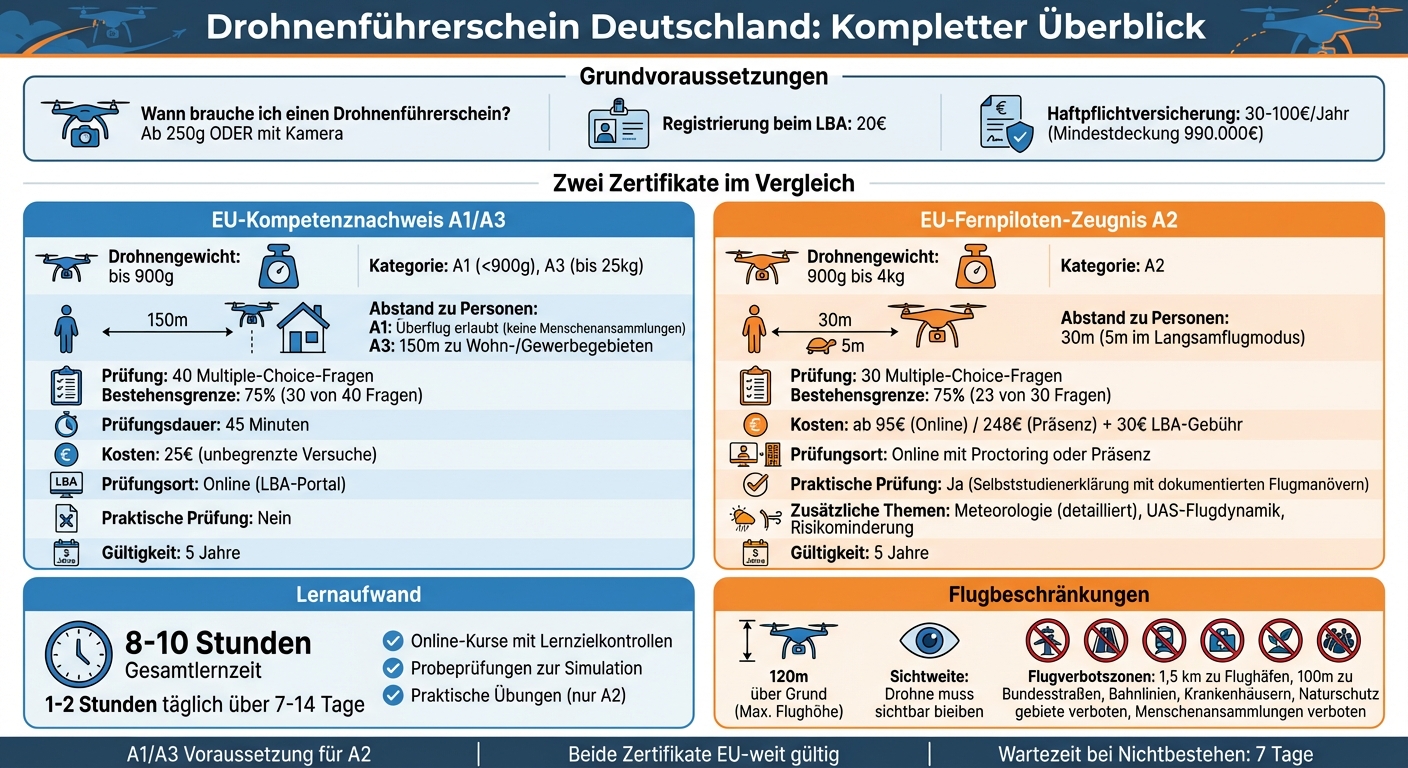
Drone license A1/A3 vs A2 comparison - costs, requirements and categories
Legal requirements for a drone pilot's license
EU drone regulation explained
EU regulations 2019/947 and 2019/945 classify drone flights into three risk categories: "Open", "Specific", and "Certified". For hobby pilots, the open category is crucial. This is further subdivided into three subcategories:
- A1: Applies to drones under 900g. Occasional overflights over uninvolved persons are permitted, but not over crowds of people.
- A2: Covers drones up to 4 kg. A safety distance of at least 30 m to people must be maintained. In slow flight mode, the distance is reduced to 5 m.
- A3: For drones up to 25 kg. A distance of at least 150 m to residential, commercial or industrial areas must be maintained.
As soon as a drone has a camera or weighs more than 250g, registration with the German Federal Aviation Office (LBA) and the EU A1/A3 competency certificate are mandatory. Those who wish to fly closer to people and use a drone weighing between 900g and 4kg additionally require the EU A2 remote aviation pilot certificate. The maximum flight altitude in the open category is 120m above ground level, and the pilot must always keep the drone within direct line of sight. These regulations form an important part of the exam questions and are therefore essential for preparation.
Registration with the Federal Aviation Office (LBA)
Registration with the German Federal Aviation Office (LBA) is mandatory for all drones weighing 250g or more, or equipped with a camera – regardless of whether they are used privately or commercially. Registration is done online and costs:
- €20.00 for private individuals
- €50.00 for legal entities
After successful registration, you will receive an electronic operator ID (e-ID), which must be clearly visible and permanently attached to each drone.
The following documents are required for registration:
- A scan of a valid identity card or passport (in PNG, JPG or PDF format)
- Details of liability insurance (insurer and policy number)
Processing takes approximately one hour with complete documentation. If a manual review is required, it can take up to 14 business days. For pilots under 16 years of age, a legal guardian must complete the application.
Required legal obligations
In Germany, liability insurance is legally required for all drones. The minimum coverage amount is 750,000 units of account, which corresponds to approximately €990,000. Since many private liability insurance policies do not cover drone flights, special aviation liability insurance is often necessary. The cost for this typically ranges from €30 to €100 per year for hobby pilots.
In addition, strict no-fly zones apply. These include:
- A safety distance of 1.5 km from airport boundaries
- 100 m distance to federal highways, railway lines and hospitals
- Bans on nature reserves and gatherings of people
To identify these zones, tools such as the Digital Platform for Unmanned Aviation (dipul.de) or the DFS drone app can be used. Furthermore, flights with camera drones weighing over 250g over private residential property require the explicit consent of the owner. Otherwise, violations of data protection law may occur.
With this basic legal knowledge, you are ideally prepared to tackle the exam content in a targeted manner.
sbb-itb-d7de319
EU Drone License: Tips for the exam | quick, easy, free
What the exam covers
The drone pilot's license exam consists of 40 multiple-choice questions for the A1/A3 competency certificate and 30 questions for the A2 remote pilot certificate. To pass, you must answer at least 75% of the questions correctly. The exam content is designed to ensure you can fly safely and legally. Here's an overview of the key topics.
Air law and regulations
A large part of the exam revolves around the legal and practical aspects of drone flying. The focus is primarily on EU and German aviation law. You need to know where no-fly zones are located, what altitude restrictions apply, and what distances must be maintained. Data protection issues also play an important role: In Germany, for example, it is forbidden to record faces or license plates without consent. Additionally, topics such as airspace structure and insurance requirements are covered.
Meteorology for drone pilots
Weather has a huge impact on drone flights, so your meteorological knowledge will also be tested. The A1/A3 competency certificate only covers the basics. The A2 certificate, however, requires you to delve deeper. You'll learn how wind, visibility, and air density affect flight stability and battery life, and how to correctly interpret weather reports. You'll also be tested on your ability to assess weather conditions to fly safely even in more challenging circumstances.
Flight operations and navigation
This section covers the technical aspects of your drone. This includes GPS navigation, "Return to Home" functions, and geo-awareness systems. You will also be asked about checklists, emergency procedures, and risk management. For the A2 certificate, you must additionally demonstrate knowledge of flight dynamics and performance limits to safely control heavier drones up to 4 kg.
| Exam topic | A1/A3 exam | A2 exam | Relevance |
|---|---|---|---|
| Meteorology | Basics only | Detailed | Affects stability and visibility |
| UAS flight dynamics | No | Yes | Understanding the limits of drones |
| Operating procedures | Yes | Yes | Standardized security checks |
| Risk reduction | No | Yes | Technical measures for risk reduction |
| General UAS knowledge | Yes | No | Basic components and functions |
This is how you prepare for the exam
You don't need to plan for months of preparation. Most participants pass the exam with 8 to 10 hours of study, spread over 1–2 weeks. The key lies in a structured approach and the right materials. It's best to start with well-organized online courses.
Online training courses
For the A1/A3 course, the LBA offers an online course for €25.00, including unlimited exam attempts. You can retake the exam as often as necessary until you achieve the required 75%.
If you're aiming for the A2 long-distance pilot's license, there are e-learning courses that systematically prepare you for all exam topics. These courses take about 8 to 10 hours and include learning assessments at the end of each chapter to identify knowledge gaps early on.
"The learning assessments at the end of a chapter highlight potential knowledge gaps for the learner and offer the opportunity to revisit specific learning content." – Droniq
Practice exams for exam simulation
In addition to the courses, realistic test simulations and a clear schedule will help you prepare optimally. Practice exams are particularly helpful, as they replicate the actual exam situation with multiple-choice questions and a time limit. For the A1/A3 exam, for example, you have 45 minutes to answer 40 questions.
The LBA also offers a practice exam with 20 questions, which you must pass before you are admitted to the final exam. This allows you to familiarize yourself with the format and specifically address any weaknesses.
Learning plan and timetable
An effective study plan for the A2 exam could look like this: 1 to 2 hours daily over a period of 7 to 14 days. Start with the basics from the A1/A3 course and gradually work your way up to the more challenging A2 topics.
Don't forget to schedule time for practical exercises. These include flight maneuvers such as hovering, coordinated turns, and emergency procedures, which you must document. If you are taking the exam online using proctoring software, make sure you install Google Chrome and the Proctorio extension in time.
Learning materials and resources
In addition to structured exam preparation, these resources offer the necessary theoretical and practical knowledge to be optimally prepared.
The official training materials from the authorities provide an excellent foundation for optimal exam results. One example is the LBA OpenUAV portal (lba-openuav.de), which offers modular training courses specifically for the "Open" category. Developed in cooperation with AIRCADEMY, these courses cover topics such as air law, operating procedures, and UAS classification. A particularly useful feature is the inclusion of practice exercises at the end of each module, which can be repeated as often as needed to reinforce the knowledge. These online training courses perfectly complement the official courses offered by the LBA and TÜV Rheinland.
Official LBA and TÜV Rheinland courses
As already mentioned, the LBA course for the A1/A3 certificate costs €25.00 and offers practical tools such as the “UAS Flight Checklist” for pre-flight checks and the “I'M SAFE” checklist for self-assessment of your fitness to fly.
For the A2 long-distance pilot certificate, Droniq, an LBA-designated testing center (DE.PStf.035), offers various e-learning packages. The online exam including e-learning costs €95.00, while the in-person exam costs €248.00. The courses include learning progress checks after each chapter and a final test to simulate the exam. With over 4,500 successfully conducted training courses and exams, Droniq is one of the most experienced providers. The LBA charges an additional €30.00 for the initial issuance of the A2 certificate.
Piecarté drones for practice
Besides theory, practical experience is essential. Special training drones from Piecarté are an excellent choice for this. Practical flight experience is particularly crucial for the A2 certificate, as the LBA's self-study guide requires documented flight maneuvers such as hovering, coordinated turns, and emergency procedures. Entry-level drones in the €80.00 to €120.00 price range are ideal for completing your first flying lessons. Piecarté offers models that are easy to control, affordable, and perfectly suited for beginners. This allows you to gain the necessary flying experience in a stress-free environment before taking the exam.
Tips for passing the exam
In addition to the learning materials provided, these tips can help you to successfully pass your exam.
Identify and improve weaknesses
The official LBA training modules include learning objective checks at the end of each chapter to help you identify knowledge gaps. Use these tests to address weaknesses directly. Especially for the A2 certificate, you should focus on the three main topics: meteorology , UAS flight performance , and technical and operational risk mitigation . These areas are particularly important in the exam.
A common stumbling block is the multitude of abbreviations in the learning materials. It's best to create a list of technical terms and abbreviations early on to avoid confusion during the exam. Furthermore, it is legally required that you thoroughly read your drone's user manual. According to EU Regulation 2019/947:
"Every drone remote pilot [must be] familiar with the user manual provided by the manufacturer."
The LBA's practical self-study guide offers helpful guidance for the A2 exam. Here you'll find a list of flight maneuvers and scenarios, such as flying in unusual conditions, GPS failure, or people entering the flight zone. This checklist will help you specifically improve your practical skills.
Once you have optimized these areas, you can use the following strategies to specifically prepare for the exam.
Examination strategies
Once you've addressed your weaknesses, these strategies will help you pass the exam. The passing grade is 75% correct answers. You have approximately 1 to 1.5 minutes per question – so plan carefully to avoid running out of time.
For proctored online exams (A2 and STS), you need the Google Chrome browser and the Proctorio extension. Make sure you have a stable internet connection (at least 1 Mbps) and are in a quiet room. Before the exam starts, a 360-degree room scan will be performed using your webcam. The AI-powered monitoring reliably detects any attempts to cheat.
If you fail the exam, request detailed feedback to make targeted improvements. Also, be aware of the legally required waiting period of 7 days before you can retake the exam.
Conclusion
The path to obtaining a drone pilot's license in Germany is clearly regulated: Start with the A1/A3 certificate, which you can acquire via the LBA portal for €25.00. If necessary, you can supplement this with the A2 certificate. Both exams have a passing grade of 75% and are valid for 5 years. Don't forget to register with the LBA as an operator (cost: €20.00), as the e-ID is a prerequisite for operating your drone.
The official training modules and practice tests of the LBA (German Federal Aviation Office) provide an excellent foundation for your preparation. For practical exercises such as hovering, turns, or emergency procedures, it is recommended to train with a suitable drone. Also, check whether your drone has a C-class registration, as this determines the required license and the applicable separation distance rules.
Additionally, drone liability insurance is legally required and must not be omitted under any circumstances.
With careful preparation, the right materials, and sufficient practice, you'll be well-equipped to successfully complete the exam. This concise guide provides the ideal foundation for obtaining your drone pilot's license.
FAQs
What certificate do I need for my drone?
In Germany, you need the EU A1/A3 competency certificate if you fly a drone weighing between 250 and 500 grams, or for drones weighing between 2 and 25 kilograms. However, if your drone weighs between 500 grams and 2 kilograms, you also need the EU A2 remote pilot certificate. Which certificates you need depends on the drone's weight and the operating conditions.
Which drones are exempt from licensing and registration?
Drones do not require a license or registration if they weigh less than 250g and do not have a camera or sensors that collect personal data. This regulation applies in particular to toy drones or models that do not have data collection functions and is based on legal provisions.
How does the A2 exam work online with proctoring?
The A2 exam with proctoring is conducted as a secure online exam using AI-supported monitoring. A camera observes the participants' behavior to ensure that no cheating attempts are made. At the beginning of the exam, a reference image is taken to confirm the participants' identities. Direct human supervision is not required.