Drone pilot's license in Germany: How to pass the exam
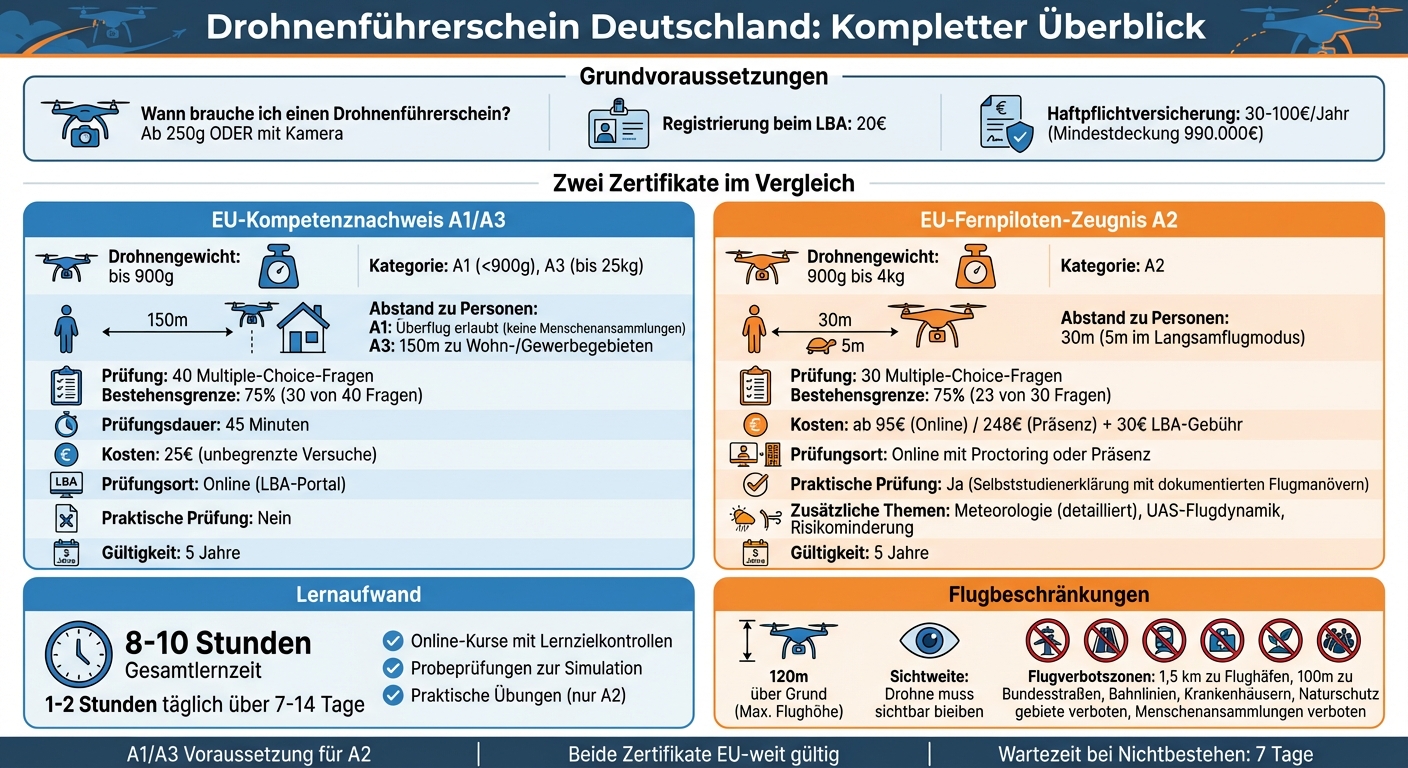
Since 2021, a drone pilot's license is required in Germany for drones weighing 250g or more, or those equipped with a camera. There are two certificates: the EU Certificate of Competence (A1/A3) for low-risk flights and the EU Remote Pilot Certificate (A2) for flights closer to people. Both licenses are valid for five years and require passing an exam with at least 75% correct answers.
Key facts:
Mandatory: Drones weighing 250g or more, or equipped with a camera.
Categories: A1/A3 (up to 900 g, safe distance), A2 (up to 4 kg, closer to people).
Costs: Registration with the LBA (€20), A1/A3 exam (€25), A2 exam (from €95).
Insurance: Liability insurance is required.
Preparation: Online courses and practice tests (8–10 hours of study time).
With structured preparation and the right materials, the exam is quite manageable.
Drone license A1/A3 vs A2 comparison - costs, requirements and categories
Legal requirements for a drone pilot's license
EU drone regulation explained
EU regulations 2019/947 and 2019/945 classify drone flights into three risk categories: "Open", "Specific", and "Certified". For hobby pilots, the open category is crucial. This is further subdivided into three subcategories:
A1: Applies to drones under 900g. Occasional overflights over uninvolved persons are permitted, but not over crowds of people.
A2: Covers drones up to 4 kg. A safety distance of at least 30 m to people must be maintained. In slow flight mode, the distance is reduced to 5 m.
A3: For drones up to 25 kg. A distance of at least 150 m to residential, commercial or industrial areas must be maintained.
As soon as a drone has a camera or weighs more than 250g, registration with the German Federal Aviation Office (LBA) and the EU A1/A3 competency certificate are mandatory. Those who wish to fly closer to people and use a drone weighing between 900g and 4kg additionally require the EU A2 remote aviation pilot certificate. The maximum flight altitude in the open category is 120m above ground level, and the pilot must always keep the drone within direct line of sight. These regulations form an important part of the exam questions and are therefore essential for preparation.
Registration with the German Federal Aviation Office (LBA) is mandatory for all drones weighing 250g or more, or equipped with a camera – regardless of whether they are used privately or commercially. Registration is done online and costs:
€20.00 for private individuals
€50.00 for legal entities
After successful registration, you will receive an electronic operator ID (e-ID), which must be clearly visible and permanently attached to each drone.
The following documents are required for registration:
A scan of a valid identity card or passport (in PNG, JPG or PDF format)
Details of liability insurance (insurer and policy number)
Processing takes approximately one hour with complete documentation. If a manual review is required, it can take up to 14 business days. For pilots under 16 years of age, a legal guardian must complete the application.
Required legal obligations
In Germany, liability insurance is legally required for all drones. The minimum coverage amount is 750,000 units of account, which corresponds to approximately €990,000. Since many private liability insurance policies do not cover drone flights, special aviation liability insurance is often necessary. The cost for this typically ranges from €30 to €100 per year for hobby pilots.
In addition, strict no-fly zones apply. These include:
A safety distance of 1.5 km from airport boundaries
100 m distance to federal highways, railway lines and hospitals
Bans on nature reserves and gatherings of people
To identify these zones, tools such as the Digital Platform for Unmanned Aviation (dipul.de) or the DFS drone app can be used. Furthermore, flights with camera drones weighing over 250g over private residential property require the explicit consent of the owner. Otherwise, violations of data protection law may occur.
With this basic legal knowledge, you are ideally prepared to tackle the exam content in a targeted manner.
sbb-itb-d7de319
EU Drone License: Tips for the exam | quick, easy, free
What the exam covers
The drone pilot's license exam consists of 40 multiple-choice questions for the A1/A3 competency certificate and 30 questions for the A2 remote pilot certificate. To pass, you must answer at least 75% of the questions correctly. The exam content is designed to ensure you can fly safely and legally. Here's an overview of the key topics.
Air law and regulations
A large part of the exam revolves around the legal and practical aspects of drone flying. The focus is primarily on EU and German aviation law. You need to know where no-fly zones are located, what altitude restrictions apply, and what distances must be maintained. Data protection issues also play an important role: In Germany, for example, it is forbidden to record faces or license plates without consent. Additionally, topics such as airspace structure and insurance requirements are covered.
Meteorology for drone pilots
Weather has a huge impact on drone flights, so your meteorological knowledge will also be tested. The A1/A3 competency certificate only covers the basics. The A2 certificate, however, requires you to delve deeper. You'll learn how wind, visibility, and air density affect flight stability and battery life, and how to correctly interpret weather reports. You'll also be tested on your ability to assess weather conditions to fly safely even in more challenging circumstances.
Flight operations and navigation
This section covers the technical aspects of your drone. This includes GPS navigation, "Return to Home" functions, and geo-awareness systems. You will also be asked about checklists, emergency procedures, and risk management. For the A2 certificate, you must additionally demonstrate knowledge of flight dynamics and performance limits to safely control heavier drones up to 4 kg.
Exam topic
A1/A3 exam
A2 exam
Relevance
Meteorology
Basics only
Detailed
Affects stability and visibility
UAS flight dynamics
No
Yes
Understanding the limits of drones
Operating procedures
Yes
Yes
Standardized security checks
Risk reduction
No
Yes
Technical measures for risk reduction
General UAS knowledge
Yes
No
Basic components and functions
This is how you prepare for the exam
You don't need to plan for months of preparation. Most participants pass the exam with 8 to 10 hours of study, spread over 1–2 weeks. The key lies in a structured approach and the right materials. It's best to start with well-organized online courses.
Online training courses
For the A1/A3 course, the LBA offers an online course for €25.00, including unlimited exam attempts. You can retake the exam as often as necessary until you achieve the required 75%.
If you're aiming for the A2 long-distance pilot's license, there are e-learning courses that systematically prepare you for all exam topics. These courses take about 8 to 10 hours and include learning assessments at the end of each chapter to identify knowledge gaps early on.
"The learning assessments at the end of a chapter highlight potential knowledge gaps for the learner and offer the opportunity to revisit specific learning content." – Droniq
Practice exams for exam simulation
In addition to the courses, realistic test simulations and a clear schedule will help you prepare optimally. Practice exams are particularly helpful, as they replicate the actual exam situation with multiple-choice questions and a time limit. For the A1/A3 exam, for example, you have 45 minutes to answer 40 questions.
The LBA also offers a practice exam with 20 questions, which you must pass before you are admitted to the final exam. This allows you to familiarize yourself with the format and specifically address any weaknesses.
Learning plan and timetable
An effective study plan for the A2 exam could look like this: 1 to 2 hours daily over a period of 7 to 14 days. Start with the basics from the A1/A3 course and gradually work your way up to the more challenging A2 topics.
Don't forget to schedule time for practical exercises. These include flight maneuvers such as hovering, coordinated turns, and emergency procedures, which you must document. If you are taking the exam online using proctoring software, make sure you install Google Chrome and the Proctorio extension in time.
Learning materials and resources
In addition to structured exam preparation, these resources offer the necessary theoretical and practical knowledge to be optimally prepared.
The official training materials from the authorities provide an excellent foundation for optimal exam results. One example is the LBA OpenUAV portal (lba-openuav.de), which offers modular training courses specifically for the "Open" category. Developed in cooperation with AIRCADEMY, these courses cover topics such as air law, operating procedures, and UAS classification. A particularly useful feature is the inclusion of practice exercises at the end of each module, which can be repeated as often as needed to reinforce the knowledge. These online training courses perfectly complement the official courses offered by the LBA and TÜV Rheinland.
As already mentioned, the LBA course for the A1/A3 certificate costs €25.00 and offers practical tools such as the “UAS Flight Checklist” for pre-flight checks and the “I'M SAFE” checklist for self-assessment of your fitness to fly.
For the A2 long-distance pilot certificate,Droniq, an LBA-designated testing center (DE.PStf.035), offers various e-learning packages. The online exam including e-learning costs €95.00, while the in-person exam costs €248.00. The courses include learning progress checks after each chapter and a final test to simulate the exam. With over 4,500 successfully conducted training courses and exams, Droniq is one of the most experienced providers. The LBA charges an additional €30.00 for the initial issuance of the A2 certificate.
Piecarté drones for practice
Besides theory, practical experience is essential. Special training drones from Piecarté are an excellent choice for this. Practical flight experience is particularly crucial for the A2 certificate, as the LBA's self-study guide requires documented flight maneuvers such as hovering, coordinated turns, and emergency procedures. Entry-level drones in the €80.00 to €120.00 price range are ideal for completing your first flying lessons. Piecarté offers models that are easy to control, affordable, and perfectly suited for beginners. This allows you to gain the necessary flying experience in a stress-free environment before taking the exam.
Tips for passing the exam
In addition to the learning materials provided, these tips can help you to successfully pass your exam.
Identify and improve weaknesses
The official LBA training modules include learning objective checks at the end of each chapter to help you identify knowledge gaps. Use these tests to address weaknesses directly. Especially for the A2 certificate, you should focus on the three main topics: meteorology , UAS flight performance , and technical and operational risk mitigation . These areas are particularly important in the exam.
A common stumbling block is the multitude of abbreviations in the learning materials. It's best to create a list of technical terms and abbreviations early on to avoid confusion during the exam. Furthermore, it is legally required that you thoroughly read your drone's user manual. According to EU Regulation 2019/947:
"Every drone remote pilot [must be] familiar with the user manual provided by the manufacturer."
The LBA's practical self-study guide offers helpful guidance for the A2 exam. Here you'll find a list of flight maneuvers and scenarios, such as flying in unusual conditions, GPS failure, or people entering the flight zone. This checklist will help you specifically improve your practical skills.
Once you have optimized these areas, you can use the following strategies to specifically prepare for the exam.
Examination strategies
Once you've addressed your weaknesses, these strategies will help you pass the exam. The passing grade is 75% correct answers. You have approximately 1 to 1.5 minutes per question – so plan carefully to avoid running out of time.
For proctored online exams (A2 and STS), you need the Google Chrome browser and the Proctorio extension. Make sure you have a stable internet connection (at least 1 Mbps) and are in a quiet room. Before the exam starts, a 360-degree room scan will be performed using your webcam. The AI-powered monitoring reliably detects any attempts to cheat.
If you fail the exam, request detailed feedback to make targeted improvements. Also, be aware of the legally required waiting period of 7 days before you can retake the exam.
Conclusion
The path to obtaining a drone pilot's license in Germany is clearly regulated: Start with the A1/A3 certificate, which you can acquire via the LBA portal for €25.00. If necessary, you can supplement this with the A2 certificate. Both exams have a passing grade of 75% and are valid for 5 years. Don't forget to register with the LBA as an operator (cost: €20.00), as the e-ID is a prerequisite for operating your drone.
The official training modules and practice tests of the LBA (German Federal Aviation Office) provide an excellent foundation for your preparation. For practical exercises such as hovering, turns, or emergency procedures, it is recommended to train with a suitable drone. Also, check whether your drone has a C-class registration, as this determines the required license and the applicable separation distance rules.
Additionally, drone liability insurance is legally required and must not be omitted under any circumstances.
With careful preparation, the right materials, and sufficient practice, you'll be well-equipped to successfully complete the exam. This concise guide provides the ideal foundation for obtaining your drone pilot's license.
FAQs
What certificate do I need for my drone?
In Germany, you need the EU A1/A3 competency certificate if you fly a drone weighing between 250 and 500 grams, or for drones weighing between 2 and 25 kilograms. However, if your drone weighs between 500 grams and 2 kilograms, you also need the EU A2 remote pilot certificate. Which certificates you need depends on the drone's weight and the operating conditions.
Which drones are exempt from licensing and registration?
Drones do not require a license or registration if they weigh less than 250g and do not have a camera or sensors that collect personal data. This regulation applies in particular to toy drones or models that do not have data collection functions and is based on legal provisions.
How does the A2 exam work online with proctoring?
The A2 exam with proctoring is conducted as a secure online exam using AI-supported monitoring. A camera observes the participants' behavior to ensure that no cheating attempts are made. At the beginning of the exam, a reference image is taken to confirm the participants' identities. Direct human supervision is not required.
Newsletter
Sign up for our newsletter so you never miss a new blog post!
How long does a drone fly on one battery? What the minutes figure means, how much wind and cold cost you and how spare batteries get you more out of every outing.
Six beginner drones under 250 g compared: DJI Neo, Mini 4K, Mini 3 Pro, Mini 4 Pro, Potensic ATOM and Autel EVO Nano+ with prices, flight times and safety features.