Violations can result in fines of up to €50,000 or even imprisonment. Those who want to fly safely should comply with all regulations and avoid sensitive areas such as crowds or no-fly zones.
Tip: Check the DIPUL map or a drone app before every flight to avoid no-fly zones.
Drone laws 2025: All rules for drone pilots for DJI Mini 4 Pro, DJI Mini 4K & Neo etc.
sbb-itb-d7de319
Drone laws in Germany
The legal framework for drone flights in Germany is based on a two-tier system: EU Regulation 2019/947 of the European Union Aviation Safety Agency (EASA) provides the general framework, while the German Air Traffic Regulations (LuftVO), in particular Section 21h, stipulate additional national rules. The following sections explain the EU-wide provisions and the specific German regulations in more detail.
EU Drone Regulation
The EU regulation categorizes drone flights into three risk categories: Open (low risk, no permit required), Specific (medium risk, permit required), and Certified (high risk, certification required). For residential areas, the Open category is particularly relevant, which is further divided into three subcategories:
Category A1: Drones weighing less than 250 g (C0) or less than 900 g (C1) are permitted to fly over populated areas. Flying over uninvolved persons must be avoided. Intentionally flying over crowds of people is prohibited.
Category A2: Drones up to 4 kg (C2) may be operated in residential areas with a minimum horizontal distance of 30 m to people. In slow flight mode, a distance of 5 m is sufficient. An A2 remote pilot certificate is required.
Category A3: For drones up to 25 kg (C3/C4), a minimum distance of 150 m to residential, commercial or industrial areas applies.
Additionally, the Open category has a maximum flight altitude of 120 meters above ground level. Drones weighing over 250 grams or equipped with a camera must be registered with the German Federal Aviation Office (LBA). Registration costs are €20 for private individuals and €50 for legal entities. The electronic operator ID (e-ID) must be visibly displayed on the drone. Since January 1, 2024, drones in classes C1, C2, and C3 must also transmit a remote ID.
German national laws and restrictions
Germany supplements EU regulations with stricter national rules, particularly regarding the protection of privacy and residential areas. According to Section 21h of the German Air Traffic Regulations (LuftVO), drones weighing over 250g or equipped with cameras may not fly over residential properties without explicit permission. This regulation goes beyond EU requirements and protects the rights of property owners.
Another important regulation is the general insurance requirement for drone flights. According to the German Air Traffic Act (LuftVG §37), liability insurance is mandatory, regardless of the drone's weight or purpose. Annual premiums for hobby pilots typically range from €30 to €100.
The minimum age for independent drone flights is 16. Furthermore, safety distances of approximately 100 meters must be maintained from federal highways, railway lines, power plants, hospitals, and nature reserves. These additional regulations underscore Germany's efforts to ensure the safe and responsible operation of drones.
Requirements for drone flights in residential areas
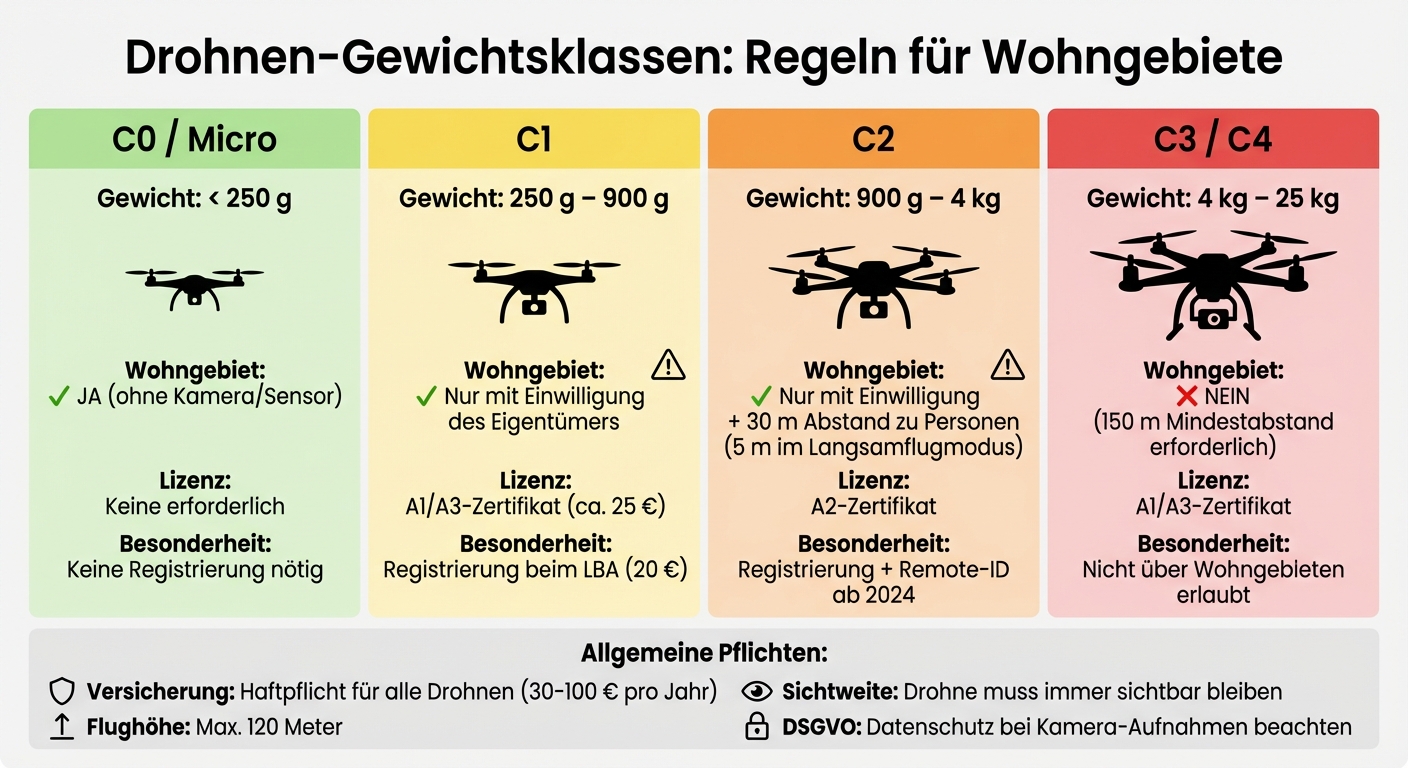
Drone weight classes and regulations for residential areas in Germany
Drone weight classes and permits
The weight of a drone plays a crucial role when it comes to flights over residential areas. Drones under 250g without a camera or sensors are generally permitted to fly over residential properties without major restrictions. However, as soon as a camera is installed or the weight exceeds 250g, stricter regulations apply.
For drones weighing between 250g and 900g (Class C1), the landowner's permission is required. Pilots must also present the EU A1/A3 competency certificate, which can be purchased online for approximately €25. Even stricter requirements apply to drones up to 4kg (Class C2): a horizontal distance of at least 30 meters to uninvolved persons is mandatory, which can be reduced to 5 meters in slow-flight mode. An A2 remote pilot certificate is also required.
Drone class
Weight
Residential area permitted?
Required license
C0 / Micro
< 250 g
Yes (without camera/sensor) Camera use only with consent
No
C1
250 g – 900 g
Only with consent
A1/A3 certificate
C2
900 g – 4 kg
Only with consent + 30 m distance
A2 certificate
C3 / C4
4 kg – 25 kg
No (150 m distance required)
A1/A3 certificate
These regulations are essential to making drone flights in residential areas legal and safe.
Consent and data protection rules
Drones with cameras that exceed the aforementioned weight classes are prohibited from flying over residential properties without the express consent of the owner or resident. This rule protects privacy and the right to informational self-determination. As technology expert Mateusz Kaczmarek explains:
"It is illegal to fly over residential private property with a camera-equipped drone >0.25kg without the owner's consent."
Additionally, the GDPR applies to drone footage. If people, license plates, or private areas are recognizably filmed, a legal basis for data processing must exist. Alternatively, the recordings must be anonymized before publication. Secretly recording private conversations with drones is a criminal offense and constitutes a violation of the regulations on acoustic surveillance.
Registration, insurance and licenses
In addition to weight and consent requirements, drone operators have further obligations. In Germany, liability insurance is mandatory for all drones, regardless of weight. The cost for hobby pilots ranges from €30 to €100 per year. Operator registration with the Federal Aviation Office (LBA) is also required. The resulting e-ID must be permanently and clearly affixed to the drone.
Since January 1, 2024, a new regulation has been in effect: drones in classes C1, C2, and C3 must transmit a remote ID so that authorities can identify the operator during flight. These measures, combined with the weight class regulations, help to ensure safety and privacy in residential areas.
Fines and penalties for violations
Common violations and fine amounts
Drone flights that violate regulations can be very expensive. Serious offenses can result in fines of up to €50,000. If you fly without the necessary EU certification (A1/A3 or A2), you face fines of up to €1,000. Failure to have the required liability insurance can cost up to €5,000. Flying over crowds without permission is particularly risky – fines of up to €5,000 are also possible. And flying in no-fly zones such as airports, nature reserves, or industrial sites is especially dangerous, with fines of up to €50,000.
In addition to fines, serious violations can also lead to criminal prosecution. Endangering air traffic is punishable under Section 315 of the German Criminal Code (StGB) by imprisonment for six months to ten years. Unauthorized entry into restricted airspace (ED-R) is also a criminal offense. Data protection violations, such as secretly filming people or property without consent, can be punished with up to two years' imprisonment under Section 201a of the German Criminal Code (StGB). GDPR violations could theoretically even result in fines of up to €20,000,000.
Type of offense
Legal basis
Maximum penalty
Flight into a no-fly zone
Air Regulations / EU 2019/947
€50,000 fine
Missing drone insurance
Air Traffic Act
€5,000 fine
Missing license (A1/A3 or A2)
Air Regulations
€1,000 fine
Missing operator registration
Air Regulations
€500 fine
Flight over crowds of people
Air Regulations
€5,000 fine
Data protection breach (recordings)
Section 201a of the German Criminal Code
2 years imprisonment or a fine
Dangerous air traffic disruption
Section 315 of the German Criminal Code
6 months to 10 years imprisonment
In particularly serious cases, the police or the Federal Aviation Office can confiscate your drone directly. Those who follow the regulations will avoid this trouble – and protect others.
This is how you stay compliant with the rules.
Adhering to the rules is not only important to avoid fines, but also ensures greater safety. Before taking off, you should always check the geofences. Helpful tools for this are the DIPUL map (Digital Platform for Unmanned Aviation) or the Droniq app. These show you current no-fly zones and temporary restrictions (NOTAMs). You should also maintain a distance of at least 100 meters from sensitive areas such as highways, railway lines, hospitals, or power plants.
Don't forget to have the necessary documents with you on every flight: the EU Certificate of Competence (A1/A3 or A2), the operator registration (e-ID), and proof of insurance. It's also important that the e-ID is clearly visible and permanently attached to the drone. Your liability insurance must specifically cover drone flights.
If you fly over residential areas, you need the explicit permission of the property owner – at least if your drone weighs more than 250g or has a camera. Also, adhere to the maximum permitted flight altitude of 120 meters and ensure that the drone always remains within your line of sight. A flashing green light is required for night flights.
What should I do if a drone flies over my property?
Rights of landowners
If a drone flies over your property without permission, you have rights that protect you. The airspace above your property, up to a certain altitude, belongs to you. German law, in combination with the GDPR, protects you from unauthorized aerial photography. Specifically, drones with cameras and weighing more than 0.25 kg are not allowed to fly over your residential property without your explicit consent (§21h LuftVO).
Drone footage showing private spaces such as windows or fenced gardens violates Section 201a of the German Criminal Code (StGB). Images in which you or your license plate are recognizable also fall under the protection of the GDPR. In these cases, the drone pilot must have a legal basis for taking the footage.
Steps to take in case of unauthorized drone flights
If you notice a drone flying over your property, it's important to remain calm and act thoughtfully. If the pilot is nearby, speak to them. Often, they are unaware that they are breaking rules or infringing on your privacy. Politely ask them to end the flight and, if necessary, delete any recordings.
Additionally, you should document the location, time, and flight behavior of the drone. This information can be helpful if legal action is taken. You can use the DIPUL map to check no-fly zones.
If the drone is flying dangerously or you feel harassed, contact the local police. In case of violations of aviation regulations, you can also contact the Federal Aviation Office. Important: Do not be tempted to shoot down or damage the drone – this could be considered property damage and have legal consequences. In case of repeated incidents, you can take legal action as described in the next section.
Legal action and height regulations
Should the problem occur frequently, careful documentation and contacting the relevant authorities are crucial. A lawyer can send a cease and desist letter to the drone pilot to prevent further overflights. In cases of serious violations of data protection or personal rights, civil action can also be taken.
Stricter rules often apply in controlled airspace, such as near airports. Here, the permitted flight altitude may be limited to 50 meters or less. In rare cases, shooting down drones has been legally recognized as self-defense, but such measures are highly controversial and should only be considered as a last resort.
Conclusion
In Germany, drone flights are permitted in residential areas as long as certain rules are followed. Those who know and adhere to these regulations can operate their drones safely and legally. The most important requirements include: registration with the Federal Aviation Office (LBA) for drones weighing over 250g or equipped with a camera (cost: €20 for private individuals), liability insurance (from €30 per year), and the EU A1/A3 certificate of competence for drones weighing 250g or more (approximately €25). These points form the basis for safe drone operation in urban areas.
In residential areas, drones with cameras weighing 250g or more always require the permission of the property owner. Furthermore, the maximum flight altitude of 120 meters must not be exceeded, and the drone must remain within direct line of sight at all times. Check the DIPUL map before each flight to ensure you do not fly over no-fly zones such as airports (minimum distance: 1.5 km) or hospitals.
Anyone who violates the regulations risks hefty fines: these can reach up to €50,000. Without insurance, you are personally liable for all damages caused. Make sure your e-ID is clearly visible on your drone and always carry your registration confirmation, proof of insurance, and proof of competence with you. This will not only help you avoid fines but also contribute to respectful and safe airspace management.
With careful preparation and consideration for privacy and safety, nothing stands in the way of a smooth drone flight. These regulations strike a balance between protecting privacy and the enjoyment of flying drones.
FAQs
Does the consent also apply to tenants?
Permission to use drones generally also applies to tenants. However, the owner or the person using the property bears the responsibility for operating the drone. All legal requirements and data protection regulations must be strictly observed.
What counts as a "crowd of people"?
In Germany, a group of people not directly involved in the drone flight is referred to as a crowd. When operating a drone, a minimum horizontal distance of 30 meters must be maintained from these uninvolved persons.
Which drones need remote ID?
Since 2024, an important change has been in effect for drones of classes C1, C2, and C3. According to the EU drone regulation, these drones must be equipped with a so-called remote ID.
The remote ID allows the drone to be uniquely identified during flight. The aim of this regulation is to increase airspace safety while simultaneously facilitating the monitoring and tracking of drone activity.
Newsletter
Sign up for our newsletter so you never miss a new blog post!
How long does a drone fly on one battery? What the minutes figure means, how much wind and cold cost you and how spare batteries get you more out of every outing.
Six beginner drones under 250 g compared: DJI Neo, Mini 4K, Mini 3 Pro, Mini 4 Pro, Potensic ATOM and Autel EVO Nano+ with prices, flight times and safety features.