

Ring light for beauty, make-up & photography
Newsletter
Latest articles

A ring light provides even, shadow-free illumination – ideal for makeup, photography, and beauty applications. The circular light source minimizes shadows, making skin appear smoother and colors more natural. Modern LED models offer adjustable color temperatures (3,000–5,600 K) and are more energy-efficient than older fluorescent versions. For makeup artists and photographers, a high CRI (over 95) is crucial for accurate color reproduction. Portable, battery-operated models make ring lights practical for mobile use.
Highlights:
- Advantages: Shadow-free lighting, natural color reproduction, vivid eye reflections.
- Areas of application: Make-up, eyelash extensions, nail design, before-and-after photos.
- Technical details: Color temperature 3,000–6,500 K, CRI value 95+, dimmable brightness.
- Price range: €16.50 to €268.00, depending on size and features.
Whether at home or in the studio – a ring light improves light quality and ensures professional results.
Neewer Ring Light Set | Unpacking & testing
sbb-itb-d7de319
Why Make-up Artists Need Ring Lights
For makeup artists, even, shadow-free lighting is essential. Conventional ceiling lights often cast harsh shadows that make the precise application of foundation, contour, or blush difficult. Ring lights, on the other hand, with their circular design, eliminate these shadows and ensure even illumination. Models with a Color Rendering Index (CRI) above 95 are particularly ideal, as they reproduce colors true to life — a crucial advantage when selecting foundation or eyeshadow shades. This results in more precise makeup application and a more professional finish.
"The circular light ring design provides even illumination, eliminating shadows and ensuring that all areas of the [face] are evenly lit." – Seming Lighting
Shadow-free lighting for precise makeup application
The perfect color temperature for makeup lies between 4,800 K and 6,000 K. Within this range, skin appears neither too cool nor too warm, and details remain clearly visible. Yellow light should be avoided, as it can lead to an overapplication of concealer. Neon lights, on the other hand, make skin appear pale and encourage the use of too much foundation.
Positioning tip: Place the ring light 45–60 cm from your face and slightly above eye level, with a slight downward tilt. For self-application, it is recommended to place a mirror centrally within the ring light. This ensures even illumination of the face.
Portable solutions for mobile makeup artists
Mobile makeup artists often face the challenge of working in locations with poor or uneven lighting – be it hotel rooms or wedding venues. Portable ring lights with flexible power options such as USB charging, integrated rechargeable batteries, or external lithium-ion batteries offer a practical solution.
Some models weigh as little as 131 g and fit easily into any work bag. Foldable, height-adjustable stands also allow for use on a wide variety of work surfaces, from low vanity tables to improvised workstations. This ensures optimal lighting at all times – no matter where you're working.
"Even amateurs can present themselves as professionals with one simple addition to their inventory; the ring light." – ETOILE
Color temperature guide for makeup and photography
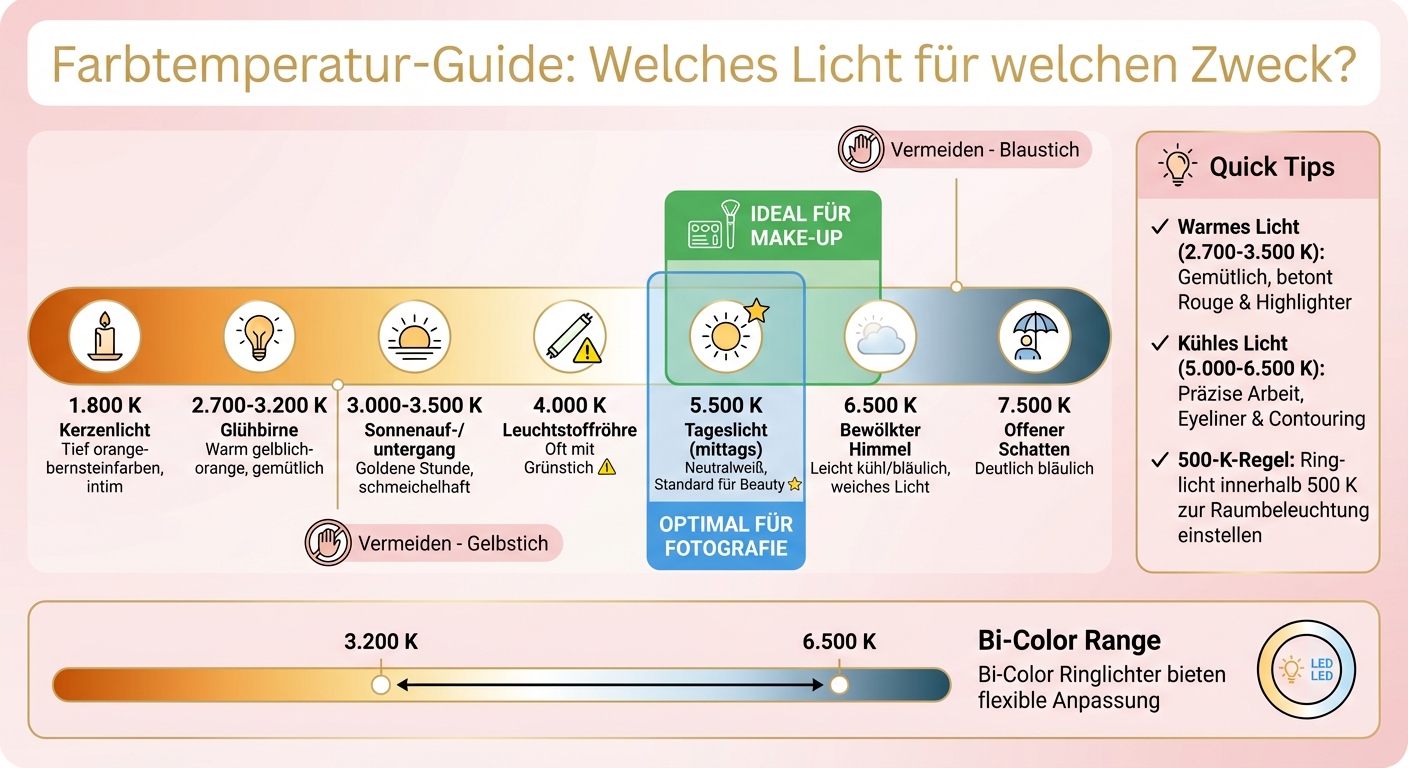
Color temperature guide for makeup and photography: Kelvin values compared
Color temperature, measured in Kelvin (K), influences whether light appears warm (yellowish-orange) or cool (bluish-white). This value is crucial for realistically representing skin tones and makeup colors both in the mirror and in photographs. Light with low Kelvin values (e.g., 2,700 K) creates a warm atmosphere, while higher values above 6,500 K provide cooler, daylight-like light.
The problem? Inappropriate color temperatures can distort skin tones. Light below 3,000 K often makes skin appear yellowish, which makes choosing the right foundation difficult. Light above 6,500 K, on the other hand, can make skin appear pale or even bluish – the result often looks unnatural. The ideal range lies between 5,000 and 5,500 K, as it simulates daylight and accurately reproduces colors.
"Lighting isn't just about brightness - it's about accuracy. A mismatched color temperature can make someone look tired, unhealthy, or artificially edited." – Jordan Lee, Professional Lighting Technician & Video Producer
Warm vs. cool light: What makes the difference?
- Warm light (2,700–3,500 K): It creates a cozy atmosphere and emphasizes warm skin tones, blush, and highlighter. Perfect for evening looks, but if used too much, it can make the skin appear yellow-toned.
- Cool light (5,000–6,500 K): This light is ideal for precise work such as eyeliner or contouring. However, warm tones can appear washed out and the skin can look dull.
Here is an overview of typical light sources and their color temperatures:
| Light source | Kelvin temperature (K) | Visual effect |
|---|---|---|
| Candlelight | ~1,800 K | Deep orange-amber; intimate |
| Light bulb (tungsten) | ~2,700–3,200 K | Warm yellowish-orange; cozy |
| Sunrise/Sunset | ~3,000–3,500 K | Golden hour; flattering |
| Fluorescent tube | ~4,000 K | Often with a greenish tint |
| Daylight (at midday) | ~5,500 K | Neutral white; standard for beauty |
| Cloudy sky | ~6,500 K | Slightly cool/bluish; soft light |
| Open shadow | ~7,500 K | Distinctly bluish |
Tip: Avoid applying makeup under extremely warm light (below 3,000 K), as this can distort skin tone. For evening events, it's recommended to test the finished makeup under approximately 3,000 K to ensure it looks good in the target lighting.
Adjustable Bi-Color Ring Lights
With this knowledge, you can make the most of the flexibility of bi-color ring lights. These lights (3,200–6,500 K) allow you to adapt the lighting to different environments and avoid problems with "mixed light" — for example, when cool daylight meets warm indoor light. High-quality models offer a CRI of 97+ and a TLCI of 98+, guaranteeing a true-to-life rendering of skin tones and makeup colors.
The 500K rule is a practical guide: Adjust your ring light to within 500K of the main light source in the room to avoid color casts. For most skin tones, a range of 5,000–5,600K is optimal.
"When you do your makeup in balanced, white light, you see every color value of everything at its truest." – Sophia Porter, Professional Makeup Artist
Ring lights for eyelash extensions and nail design
For intricate work such as eyelash extensions or nail design, proper lighting is essential. It not only ensures greater precision but also enhances the quality of the results. While color temperature is the focus when applying makeup, shadow-free visibility and accurate color rendering are particularly important here. The right light quality is therefore a crucial factor for achieving perfect detail work.
Optimal visibility for precise work
A ring light produces an even, soft light that minimizes shadows – perfect for seeing individual natural eyelashes and precisely applying extensions. Shadow-free light also prevents uneven lines and helps achieve symmetry in techniques like permanent makeup or microblading.
"Poor color rendering makes it harder to choose and match pigments." – CosmoGlo
Another advantage: dimmable functions. With brightness settings from 1% to 100%, you can adjust the light to each stage of your work. This not only protects your eyes but also increases comfort during longer sessions. High-quality models boast up to 2,700 lumens and a wide color temperature range from 3,200 K to 6,500 K.
True-to-life colors thanks to a high CRI
A high CRI (Color Rendering Index) is crucial for reliably assessing colors and pigments. For work such as nail design or cosmetic tattooing, a CRI of over 90 is recommended, ideally in the range of 95 to 97+. This ensures true-to-life color reproduction.
In addition, high-quality ring lights offer stable construction – for example, with a heavy steel base or a robust aluminum tripod – as well as flexible 360° swivel arms that allow for wobble-free work. This difference can be crucial, especially when choosing eyelash or nail polish colors.
Properly lighting before-and-after photos
Before-and-after photos are a real calling card for makeup artists and beauty professionals. To ensure your work looks its best in the photos, the right lighting is crucial. Just like in a beauty salon, even, shadow-free lighting is essential.
Ring light positioning for optimal results
To illuminate the face evenly and minimize shadows, the camera should be positioned centrally within the ring light. The light itself should be placed at eye level or slightly above and tilted slightly downwards – this will create as few shadows as possible.
The ideal distance between the ring light and the face should be between 45 and 90 cm. If the light is too close, details can appear washed out; if it's too far away, the light intensity decreases. For comparison photos, it's important to use the same position, brightness, and color temperature for both shots. A slight tilt of the light helps to avoid reflections for people wearing glasses. Also, the person shouldn't stand too close to the wall to avoid distracting shadows.
Ring lights compared to other light sources
Unlike daylight, a ring light offers consistent and adjustable illumination. Daylight is often unpredictable – its color temperature changes depending on the time of day and weather, and direct sunlight can create harsh shadows. Softboxes, on the other hand, provide softer, more directional light that shapes the face and creates shadows. Ring lights, however, ensure even illumination that conceals blemishes and highlights details.
Studio vs. Home: Choose your setup
Choosing the right ring light depends largely on whether you intend to use it in a professional beauty salon or at home. Salons often use larger ring lights with a diameter of approximately 45 cm (18 inches). These offer a wider light field and more even illumination. They are usually mounted on sturdy stands (up to 10 kg) or on walls or ceilings to save space and protect sensitive equipment. Such studio models achieve an impressive brightness of up to 5,000 lux at a distance of 0.5 meters and have an adjustable color temperature range between 2,900 K and 7,000 K.
For home use, more compact models with a diameter of 12–30 cm (5–12 inches) are suitable. These can be attached using desk clamps or lightweight table stands to save space. Home models cost between €16.50 and €23.00, while professional sets range from €76.00 to €268.00. Studios almost always prefer mains-powered models, as these guarantee consistent performance even during longer sessions. These differences will help you choose the right ring light for your specific needs. Below you will find more information about the optimal equipment for studios and home use.
Equipment for professional studios
As mentioned earlier, high color fidelity is crucial. A CRI of at least 95 or a TLCI of 98 is essential. Many professional ring lights also feature digital displays that allow for precise adjustment of brightness and color temperature. For applications like eyelash extensions, flexibly adjustable swivel arms can be helpful to avoid shadows from any angle.
Ring light setup for home
For your home setup, a medium-sized ring light with adjustable brightness and color temperature is usually sufficient. A simple mounting option, such as a desk clamp, is ideal. Even at home, proper positioning is crucial for optimal results. If the light appears too intense in smaller rooms, you can soften it with a diffuser or increase the distance to create softer shadows. Many models for home use also offer integrated smartphone holders, which is particularly useful when filming makeup tutorials or taking photos. At Piecarté, you'll find a selection of ring lights that can be perfectly adapted to your needs.
What you should consider when buying a ring light
Once you've decided where you want to use your ring light – whether in the studio or at home – the technical details become important. Size and diameter are particularly crucial, as they significantly impact the light quality. Larger ring lights (around 35 to 45 cm) produce softer, more even light and considerably minimize harsh shadows.
"A good ring light for makeup will provide you with clear, soft, and consistent lighting that can accurately match foundation shades." – Daniel Wright, Neewer
Compact models are practical for the desk or on the go, but often produce a more intense and harsher light.
Another factor is color temperature. A range of 3,000 K to 6,500 K is optimal, with daylight (around 5,500 K) considered ideal. Also, pay attention to the CRI (Color Rendering Index): a value of at least 90 is recommended, while professional models often achieve values of 97 or higher.
When it comes to power supply, you have several options: USB models are ideal for on the go, mains power ensures consistent performance in the studio, and battery operation offers maximum flexibility. A dimming function is also important for stepless brightness adjustment. High-quality models offer flicker-free dimming, which is more comfortable for the eyes during extended use. Accessories such as height-adjustable tripods, smartphone holders, or ball-head mounts for cameras can also be crucial.
Key features and specifications
The diameter of your ring light greatly influences the light quality and its range of applications. An 18-inch (approximately 45 cm) model offers a good compromise between portability and professional light coverage. Larger ring lights also allow for greater distance from the model, resulting in less heat buildup and more comfortable light for the eyes.
LED ring lights are particularly energy-efficient and generate very little heat, making them ideal for extended use. An often overlooked factor is the R9 value, which is especially important for vibrant reds. A high R9 value is crucial for beauty applications to ensure authentic color reproduction on camera. Furthermore, the light should be flicker-free to avoid distracting effects during video recordings and to protect the eyes.
These aspects are relevant for both professional use in beauty salons and mobile applications, and will help you find the right ring light for your needs.
Product comparison table
Here is an overview of some popular models and their features:
| Model | Diameter | Color temperature | CRI | Price |
|---|---|---|---|---|
| Compact (Entry-level) | 12–13 cm | 3,000 K–6,000 K | 97+ | approx. €29.99 |
| Medium (Semi-Pro) | 45 cm | 2,500 K–10,000 K | 97+ | approx. €169.99 |
| Professional studio | 45 cm | 2,900 K–7,000 K | 97+ | approx. €209.99 |
| XXL Studio | 50 cm | 3,200 K–5,600 K | N/A | approx. €199.99 |
Prices vary considerably depending on the features: entry-level models with smaller diameters start at around €29.99, while professional sets with larger diameters and more functions range from €169.99 to €209.99. At Piecarté, you'll find a carefully curated selection of ring lights to suit different needs and budgets.
How to use ring lights effectively
Setup and positioning tips
Proper positioning makes all the difference. The camera or smartphone should be placed directly in the center of the ring light. This is the only way to achieve the characteristic circular light reflection in the eyes and shadow-free photos. The ring light itself should be positioned at eye level to avoid unflattering shadows.
"If your camera lens isn't in the center of your ring light, you're using it incorrectly." – Allen Murabayashi
The distance between your face and the ring light should be between 45 and 90 cm. For makeup applications, about 60 cm is ideal. Do you wear glasses? Then tilt the light slightly downwards to minimize distracting reflections.
For studio-like results, you can use the ring light as the main light and additionally place softboxes to the sides to perfectly illuminate your face. If the light appears too intense, point it at a white wall to soften it. A little tip: When shooting under the ring light, use slightly bolder colors for lips and eyes, as cameras often render colors less intensely.
Besides proper positioning, you should also pay attention to maintenance to achieve consistently good results.
Care and maintenance
Modern LED ring lights generate very little heat, so you can safely store them immediately after use. Make sure to secure the ring light head firmly to the tripod and regularly check the cable connections to prevent electrical problems. A sturdy tripod or table clamp will prevent damage to the ring light.
Avoid leaving the light at maximum brightness for extended periods when people or animals are sitting directly in front of it – this can be uncomfortable. For bi-color ring lights with a daylight setting, you should manually set your camera's white balance to "daylight" to obtain natural colors.
These tips will keep your ring light in top condition and deliver consistently good results.
Conclusion
Ring lights are a must-have for beauty professionals and makeup enthusiasts. Their circular light source minimizes shadows, ensures even illumination, and creates the popular light reflection – perfect for precise work when applying makeup, eyelash extensions, or for impressive before-and-after photos.
A diameter of approximately 45 cm and an adjustable color temperature range between 3,000 K and 6,000 K offer an ideal balance between light quality and flexibility.
Piecarté ring lights meet these requirements and deliver outstanding results both in professional studios and at home. Battery-powered models give mobile makeup artists the freedom to work anywhere, while mains-powered versions ensure consistent performance during long sessions. Features such as integrated smartphone holders and mirrors make setup particularly easy for content creators and self-application. These thoughtful features underscore the benefits and applications described in this guide.
With the right settings, correct placement, and a little care, you can get the most out of your ring light. It's an investment that quickly pays for itself through professional results and versatile applications.
FAQs
Do I really need a ring light, or is daylight sufficient?
Daylight can be a good light source when it's even and stable. However, it's often unpredictable, as it depends on factors like the time of day, the weather, and the season. A ring light, on the other hand, provides controlled and even illumination that minimizes shadows, accurately reproduces colors, and highlights details. For makeup artists, photographers, and stylists, a ring light is therefore the perfect solution for achieving professional results regardless of external lighting conditions.
How do I avoid color casts in mixed lighting?
To avoid color casts, you should use neutral lighting. A color temperature between 5000K and 5500K is ideal, as it closely resembles natural daylight. Experiment with different light sources with varying color temperatures to find even lighting that reduces color distortion caused by light that is too warm or too cool.
Which ring light size is suitable for my setup?
The ideal size of a ring light depends on its intended use and the available space. For makeup application or beauty photography, ring lights with a diameter of 38 to 48 cm are particularly suitable. They provide even lighting and create the popular ring effect in the eyes.
- Small rooms: A ring light with a diameter of 38 cm is usually sufficient here. It provides enough light without taking up too much space.
- For larger studios or professional photos: For before-and-after pictures or larger scenes, models with a 46 to 48 cm diameter are the better choice. They cover larger areas and produce more intense light.
So before you buy, consider how much space you have and what level of illumination you need.

A ring light instantly improves your video recordings: It provides even lighting, reduces shadows, and makes you look better on camera. Whether for TikTok, Instagram, live streams, or video calls – a ring light helps you achieve professional results. Models start at around €20, while professional versions can cost up to €300. Look for features like adjustable color temperature, dimmable brightness, and a central camera placement. For larger projects or a professional setup, you can combine a ring light with an additional key light.
Brief overview:
- Advantages: Even lighting, soft shadows, improved skin tone
- Prices: €20–40 (beginner), €150–300 (professional)
- Areas of application: Social media, streaming, video calls
- Key features: Color temperature (e.g., 3,000–6,000 K), CRI value of 95+, Bluetooth remote shutter release
Whether you're a beginner or a professional – the right lighting makes all the difference.
The best ring lights for TikTok and Instagram Reels
Key features for short-form video content
A ring light is essential for TikTok and Instagram Reels, especially for vertical formats. A diameter of 10–12 inches is ideal for close-ups and solo videos. If you're shooting dance videos or full-body shots, larger 18-inch models are better suited, as they provide even lighting even from several meters away.
The color temperature should be flexibly adjustable so you can adapt it to different lighting conditions. A color rendering index (CRI) of 95+ is important for realistically displaying skin tones and makeup. Additionally, the brightness should be continuously adjustable to precisely adjust the exposure without overexposing your face.
A 360° rotating smartphone holder is a must-have for vertically orienting your phone. Bluetooth remote shutter releases are a handy addition, especially for dynamic content like dance challenges. USB-powered models are ideal for on-the-go use, while mains-powered versions offer higher and more consistent brightness – perfect for your home studio.
"In the world of TikTok, your lighting setup is your silent partner in storytelling - it can make or break the emotional connection with your audience before they even hear your first word." – Instant views
Interestingly, professional ring light setups can increase video completion rates by 45% and engagement by 32%, compared to natural or overhead lighting.
Piecarté offers ring lights specifically tailored to the requirements of TikTok and Instagram.
Piecarté models for TikTok and Instagram
Piecarté offers a thoughtful selection of ring lights that are perfect for short-form videos. The 10-inch models (approximately 26 cm in diameter) are ideal for selfies and close-ups. They are easy to place on a desk and provide enough light to achieve professional results. The optimal distance between you and the light is 30–40 cm.
For larger projects like dance videos or group photos, the 18-inch models (approximately 46 cm in diameter) are ideal. These provide soft, flattering light and avoid harsh shadows. All Piecarté ring lights feature at least ten brightness levels and adjustable color temperatures to ensure natural skin tones.
Models with RGB functionality offer additional creative possibilities: they provide dynamically adjustable colors – perfect for trendy challenges and aesthetic effects. They also come with height-adjustable tripods and Bluetooth remote triggers, allowing you to position the light individually and shoot hands-free.
Piecarté ring lights start at under €50 and already cover all the essential functions for high-quality TikTok and Instagram content. Professional kits with more advanced features range from €80 to €200. All models can create the characteristic circular catchlight in the eyes – a hallmark of the ring light look.
Here's how to set up your ring light and keylight for streaming.

Ring light vs. ring light + key light - setup comparison for streaming
Instructions for a 2-point lighting setup
A two-point setup combines a key light as the main light source with a ring light as fill light. Position the key light at a 45-degree angle to your face — either at the 4 o'clock or 8 o'clock position. It should be positioned slightly above eye level and tilted slightly downwards. Place the ring light on the opposite side, also at a 45-degree angle, to balance shadows.
The intensity of the ring light should be 50–75% of that of the key light. Both lights should be positioned 90–150 cm apart. For natural skin tones, it is recommended to set both lights to a color temperature of 4000–4500 K.
A little pro tip: Position the key light so that it creates a triangle of light on the shaded cheek – this ensures a pleasing, professional look. Also, switch off ceiling lights, as these often create distracting shadows under the eyes and on the chin.
Did you know that professional lighting (over 1,000 lux) can increase viewer engagement by 47%? It also makes faces appear 23% more trustworthy. Studies also show that well-lit streams are watched for an average of 22 minutes, while poorly lit streams are often abandoned after just 12 minutes.
In the next section, we will look at how a single ring light compares to a combination with a key light.
Single ring light vs. ring light + key light
The question arises: Is a single ring light sufficient, or should you invest in an additional key light? The following comparison illustrates the differences:
| Feature | Single ring light | Ring light + Keylight |
|---|---|---|
| Lighting result | Even, flat; halo effect in the eyes | Spatial, professional; soft shadows and depth |
| Price range | €25 – €80 | €100 – €250+ |
| Best use | TikTok, Reels, beauty tutorials | Professional Twitch / YouTube streaming, interviews |
| Shadow control | Minimal shadows; can appear washed out | High control; reduces harsh shadows |
| Setup complexity | Low (directly in front of you) | Medium (requires 45-degree positioning) |
For beginners who primarily create social media content like TikToks or Reels, a single ring light is often sufficient. However, if you want to stream professionally or qualify for brand deals, investing in a key light is worthwhile. In fact, streamers with professional lighting are 1.7 times more likely to attract sponsors.
Ring light positioning: How to avoid shadows and highlights
The correct angles and distance settings
The ideal distance between your ring light and your face is between 60 and 90 cm. If the light is closer than 60 cm, overexposure and harsh shadows will occur. Conversely, if you move further away than 1.80 m, the lighting will be weaker.
For a natural result, position the ring light slightly above eye level and tilt it downwards by 15–20°. A 45-degree angle is often referred to as the "golden rule" for giving your face more depth and dimension.
Do you wear glasses? If so, you can position the ring light slightly higher and tilt it downwards to avoid distracting reflections. Alternatively, you can move it slightly to the side so that reflections don't fall directly into the camera. Important: The camera should be positioned centrally to achieve even lighting.
These settings ensure soft, even lighting that can be adapted to different scenarios.
| Angle | Visual effect | Best use |
|---|---|---|
| Right in front of you | Even light, hardly any shadows | Video calls, simple portraits |
| 45° above/to the side | More depth, softer shadows | Streaming, professional photography |
| Offset to the side | Dramatic, cinematic | Creative vlogs, artistic content |
Create even, soft light
A diffuser is your best friend when it comes to creating soft shadows and avoiding harsh light edges. If you don't have a diffuser, you can even use a stretched white bed sheet.
The brightness of the ring light should be adjusted depending on the time of day: 20–30% is sufficient during the day, while in the evening it is better to go to 50–70%.
"Using a diffuser greatly enhances soft shadows and reduces harsh glare." – Emily, beauty photographer
Do you struggle with shiny skin? A mattifying setting powder can help, or you can slightly reduce the contrast and gamma values in your camera settings. If you're shooting in daylight, set the color temperature of your ring light to 5,500 – 6,000 K to achieve natural skin tones. For a warm evening feel, 3,200 K is the right choice.
These tips will help you get the most out of your ring light and achieve professional results – whether for photos, videos or live streams.
Budget ring lights under €100 for beginners
What you should look out for when buying entry-level ring lights
A good entry-level ring light should cover the basics: adjustable color temperature and a dimming function. This allows you to switch between warm white light (around 2,700 K) and cool white light (around 6,500 K) to adapt the light to different environments. The dimming function ensures that you avoid overexposure and can adjust the brightness to your distance from the camera.
Another important point is the power supply. Models with a USB connection are particularly convenient, as you can connect them to your computer, a power bank, or a USB charger. Also, make sure that both the lamp head and the smartphone holder can rotate 360°. This allows for flexible selfies and overhead shots. A stable base or a sturdy tripod ensures that your shots aren't affected by camera shake.
The size of the ring light is also crucial: Compact models (3–10 inches) are ideal for desktop setups or mobile vlogging. Larger rings, on the other hand, provide more even light, which is perfect for studio recordings. Below you'll find an overview of Piecarté's budget ring lights, which are particularly well-suited for beginners.
Piecarté Budget Ring Light Comparison
Piecarté offers a range of entry-level models that vary in size and features. Here is an overview of some tried-and-tested options:
| Model | Price | Diameter | Special features | Ideal for |
|---|---|---|---|---|
| Piecarté 56cm ring light with tripod | €149.00 | 22 inch | 3,200–5,600 K, dimmable, 360° rotatable | Professional studio lighting |
| Piecarté 46cm RGB ring light with tripod | €149.00 | 18 inch | Remote control, many different colors | YouTube videos, TikTok |
| Piecarté 26cm Standard ring light with tripod | €49.95 | 10 inch | Smartphone holder, compact, self-timer optional | Instagram Reels, mobile vlogs |
| Piecarté 26cm ring light without tripod | €29.99 | 10 inch | ultra-portable | On the go, travel content |
All models offer 360° adjustability, allowing for maximum flexibility during shooting. Users particularly appreciate the easy installation and the ability to switch between warm and cool light tones.
Tip: Many inexpensive ring lights don't come with a USB power adapter. So you'll either need your own power adapter or another power source with a USB port. If you want to adjust the brightness and color temperature while recording, models with a remote control are a good option – this way you can conveniently control your setup without interrupting the recording.
Professional streaming setup techniques
3-point lighting configuration
If you want to take your streaming setup to the next level, you should try the 3-point lighting technique: key light (main light), fill light, and backlight. This technique creates depth, reduces harsh shadows, and clearly separates you from the background. The key light is positioned at a 45-degree angle to the camera to set the main lighting and mood. The fill light comes from the opposite side and should be about 50–75% of the key light's brightness. The backlight is positioned slightly downwards behind you to create a subtle halo of light.
A Piecarté ring light offers flexibility: use it as a fill light, combine it with a more powerful LED panel as a key light, and a small spotlight as a backlight. Typical brightness ratios range from 2:1 for a warm atmosphere to 8:1 for dramatic, cinematic effects. A standard ratio might be 100:50:20 for key:fill:back.
"If you're using a camera and want your subject to look good, then you need to know how to do 3-point lighting!" – Stephen Robles, Video & Podcast Creator
Tip: Position the backlight higher than your head and point it downwards to avoid glare in the image. In addition to artificial lighting, you can also incorporate daylight to create a more natural image.
Combining natural and artificial light
Daylight makes a great key light – position yourself so you're facing directly towards the window. Since the intensity of daylight changes throughout the day, you can use your Piecarté ring lights as fill lights or backlights to ensure even illumination.
Color temperature is important: Daylight is around 5,600 K. Set your LED lights to the same color temperature to create a harmonious lighting atmosphere. Mixing warm artificial light (3,200 K) with cooler daylight can cause problems with the camera's white balance.
If direct sunlight is too harsh, you can use a white curtain as a diffuser. Set your ring light to about 50% of the brightness of the window light to selectively brighten shadows. Manually set your camera's white balance to 5600 K for consistent skin tones.
"Great lighting makes average cameras look professional, while poor lighting makes even high-end gear look flat or grainy." – RocketPages
Conclusion
Lighting makes all the difference: No camera in the world can compensate for poor lighting. Piecarté ring lights provide soft, even light that enhances natural skin tones and creates striking ring reflections in the eyes.
The benefits of good lighting are even measurable: Studies show that streams with professional lighting (over 1,000 lux) keep viewers watching an average of 47% longer and generate 18% more chat interactions. Furthermore, according to the MIT Media Lab, well-lit faces appear 23% more trustworthy. For content creators, this translates to a 1.7-fold increase in the chances of brand collaborations with high-quality lighting.
"A good ring light transforms your webcam from grainy and amateur to professional and engaging in seconds."
– Shruti Agarwal, Streaming Equipment Expert
Whether you're just starting out with TikTok videos or already using a sophisticated 3-point setup for professional streams, the right lighting is key to greater reach and a professional appearance. Explore the Piecarté product range and find your perfect ring light: from entry-level models under €100 to high-end studio solutions with app control. A good lighting setup is not only an investment in your content, but also in your success.
FAQs
Which ring light size is suitable for my content?
Choosing the right ring light size depends on what you want to film and where you'll be using the light. For close-ups, like those common in TikTok, Instagram Reels, or YouTube videos, ring lights with a diameter of 25–30 cm are perfectly adequate. If you're working in a larger studio or need more room for movement, models with a diameter of 40 cm or more are more suitable.
The most important factors are how far away you are from the light and what lighting effect you want to achieve.
How do I prevent reflections in my glasses?
To avoid reflections when using a ring light, position it to the side, slightly elevated, and angled downwards. This reduces the likelihood of the light reflecting directly off your lenses. You can also use a diffused light source or diffuser to further soften harsh reflections. The goal is to create even, glare-free illumination without any distracting reflections.
What color temperature is ideal for streaming and TikTok?
The optimal color temperature for streaming and TikTok is between 3200K and 7500K. A neutral to warm lighting setting (4000K to 5500K) creates a particularly natural and pleasant appearance. These settings reduce shadows and glare, significantly improving image quality.

A ring light is the perfect solution when you need even lighting without harsh shadows – whether for photos, videos, makeup tutorials, or video conferences. Originally used in medicine, they are now indispensable in social media and content creation. Prices start at around €13 for compact models without a tripod and go up to €1,375 for professional systems.
Key points:
- Sizes: From 10 inches (selfies, close-ups) to 22 inches (studio shots, room lighting).
- Light sources: LED (energy-saving, long-lasting) vs. Fluorescence (softer light, but more sensitive).
- Mounts: Tripods (flexible, for larger setups) or table clamps (space-saving, ideal for desks).
- Color control: Bi-Color (warm/cold), Tri-Color (warm/cold/natural) or RGB (full color spectrum for effects).
Conclusion: Choose your ring light based on size, light type, and intended use. A 10-inch model with a USB connection is sufficient for beginners. Professionals opt for 18–22-inch models with bi-color, tri-color, or RGB functionality.
Ring light test (2026) - The best ring lights compared
sbb-itb-d7de319
Ring light sizes: 10", 14", 18", 22"

Ring light size comparison: 10, 14, 18 and 22 inches at a glance
The size of a ring light affects both its light output and its applications. Larger models often have more LEDs, resulting in higher light output and more even illumination over larger areas. Here are the specifications of the 10", 14", 18", and 22" sizes in detail:
10-inch ring light
With a diameter of approximately 26 cm, the 10-inch ring light is compact and easily portable. It is particularly suitable for selfies, makeup tutorials, or use at a fixed desk. This ring light is ideal for close-up shots and can be attached directly to a smartphone or used with a small table stand.
Price: Models of this size cost between €27.00 and €39.00. One example is the Sensyne 10", which has received over 72,100 reviews on Amazon with an average rating of 4.4/5 stars. Piecarté offers a similar ring light without a tripod for €24.99.
14-inch ring light
The 14-inch version (approximately 36 cm in diameter) is a popular all-rounder, especially among vloggers and content creators. It offers significantly wider light coverage compared to smaller models and is ideal for portrait photography or medium-sized setups. These ring lights are usually supplied with extendable tripods that reach heights of 127 to 152 cm.
Price: Sets of this size are often available for around €89.95.
18-inch ring light
With a diameter of approximately 46 cm, the 18-inch ring light is a professional standard. It's perfect for full-body shots, video shoots, or studio photography. Thanks to its larger surface area, it can illuminate not only individual faces but also small to medium-sized rooms. High-quality models, such as the NEEWER 18" RL-18, offer precise skin tones with 55 W and a color rendering index (CRI) of 97+. This model has over 76,700 reviews on Amazon with an average rating of 4.7/5 stars.
Price: Standard models cost around €149.00, while premium versions with wireless features can cost up to €270.00.
22-inch ring light
The 22-inch ring light (approx. 56 cm in diameter) is ideal for large-scale shots and studio productions. This size offers up to 2,540 lux and ensures particularly even light distribution. However, these models are less portable and require a stable tripod with a height of up to 185 cm.
Price: Models of this size start at around €81.00 without a tripod.
Ring light mounts: Tripod vs. table clamp
Choosing the right tripod depends on your workspace and individual needs. Tripods with heights between 80 cm and 200 cm are particularly suitable for professional photography, full-body shots, or video recording while standing. They can be flexibly positioned within a room and are ideal for studio productions, but they do require more space.
Table clamps and table stands, on the other hand, are compact alternatives with heights ranging from 10 cm to 73 cm. They save space on the desk and are ideal for video conferences, streaming setups, or makeup tutorials. As Welt.de aptly puts it:
"A ring light is ideal for the home office. It can be placed on the desk."
These mounts are particularly suitable for smaller workspaces where multiple monitors are used. Below you will find a detailed overview of the advantages and disadvantages of both mount types.
Tripod mount
Tripods made of aluminum or metal offer high stability and can support a ring light, camera, or smartphone. With heights ranging from 80 cm to 200 cm, they are versatile and suitable for both seated and standing shots. The Eoto Light, for example, reaches a maximum height of 185 cm.
The biggest advantage is flexibility: you can position the light almost anywhere in the room and adjust its height individually. This makes tripods the perfect choice for studio and outdoor scenarios. However, they are less portable – often requiring a carrying case for transport – and larger models usually need a mains connection to ensure constant light output.
Table clamp holder
Table clamps and small table stands are space-saving solutions for fixed workstations. They are attached to the edge of the table or stand compactly on the desk. Many models feature flexible gooseneck arms that allow for 360° rotation and various tilt angles.
These mounts are lightweight and portable. They are also typically powered via USB, making them ideal for use with laptops or power banks. The downside: their height is limited and they require a table surface.
Comparison of mounting types
| Feature | Tripod mount | Table clamp / table tripod |
|---|---|---|
| Altitude range | 80 cm – 200 cm | 10 cm – 73 cm |
| Ideal for | Studios, static shots, professional photography | Small desks, makeup, video calls, home office |
| Mobility | Lightweight (carrying bag required) | High |
| Stability | High (aluminum or metal) | Medium (design-dependent) |
| Space requirements | Tall (requires standing area) | Minimal (table edge) |
| Flexibility | Location-independent | Table area |
| Power supply | Network connection | USB |
For business meetings, a 10-14 inch ring light with a table clamp or monitor mount is recommended to achieve a professional look while taking up minimal space. Content creators who need maximum flexibility and variable lighting angles should opt for an 18-inch model with a tripod.
LED vs. Fluorescent Ring Lights
The choice between LED and fluorescent ring lights depends not only on price, but above all on their everyday practicality. Here, LED ring lights have clear advantages. While LED models consist of many small light-emitting diodes arranged in a circle, fluorescent ring lights use a single, continuous glass tube. This difference affects aspects such as energy consumption, durability, and ease of use.
LEDs set the current standard – and for good reason: they require less power, generate hardly any heat and are therefore also suitable for longer periods of use.
LED ring lights stand out with their stepless dimming capability (usually from 1% to 100%) and adjustable color temperatures between 3,200 K (warm white) and 5,500 K (daylight). Some models even offer RGB options for creative lighting effects. In contrast, fluorescent tubes are often not dimmable and require color filters, which limits their flexibility.
LEDs also excel in terms of lifespan: their robust construction makes them durable, while fluorescent tubes are made of fragile glass and break more easily. In the long run, LEDs therefore save costs. High-quality LED models also achieve a color rendering index (CRI) of over 95 Ra, ensuring true-to-life color reproduction.
Below is a detailed look at the characteristics of both types.
LED ring lights
LED ring lights are the preferred choice for content creators, makeup artists, and anyone who regularly relies on good lighting. They combine energy efficiency, durability, and maximum control. Precise adjustment of brightness and color temperature makes them versatile – whether for video calls, TikTok clips, or professional product photography.
Many models can be powered via USB, making them particularly portable. This allows them to be used with power banks or laptops. High-quality devices also offer switchable light sectors that can create targeted shadows – a feature highly valued in macro and product photography.
Examples of LED models:
- Godox LR150 LED Ring Light: approx. €44.95 to €48.00 (Rating: 4.78/5 stars)
- StudioKing LED-480ASK: approx. €109.00
- Caruba Vlogger LED Set PRO (18-inch): approx. €149.00
- Lume Cube Cordless Ring Light Pro: 4.8/5 stars based on 230 reviews
Fluorescent ring lights
Fluorescent ring lights produce a soft, even light that is valued in portrait and beauty photography. Thanks to their continuous glass tube, they create a homogeneous light distribution without visible light points. But this is where their flexibility ends.
A major disadvantage is the higher energy consumption for the same light output. Furthermore, fluorescent tubes are fragile and less portable. Battery operation is generally not possible, as these models almost always require a mains connection. Their shorter lifespan also leads to higher follow-up costs.
Example of a fluorescence model:
- Falcon Eyes FLC-65 (65 W): approx. €108.48
By 2026, fluorescent ring lights will be virtually non-existent in the consumer sector, as LEDs will dominate the market.
LED vs. Fluorescence: A Comparison
The following table shows the main differences between LED and fluorescent ring lights:
| Feature | LED ring lights | Fluorescent ring lights |
|---|---|---|
| Light source | Many small light-emitting diodes | Single circular glass tube |
| Dimmability | Continuously variable (0–100%) | Mostly not dimmable |
| Color temperature | Adjustable (3,200–5,500 K), RGB | Mostly fixed, filter required |
| Energy consumption | Very low | Higher at the same brightness |
| Life | Long, robust | Shorter, fragile |
| Heat generation | Minimal | Noticeable with prolonged use |
| Power supply | Mains, USB or battery (NP-F) | Usually just a network connection |
| Robustness | High (shockproof) | Small (fragile) |
| Ideal for | Vlogging, makeup, video, photography | Special artistic applications |
For most applications – from video conferencing to professional photography – LED ring lights are the better choice. They offer greater control, lower operating costs, and a longer lifespan. Fluorescent ring lights remain an option for specific applications where their light characteristics are required.
Bi-color, tri-color and RGB ring lights
Bi-color, tri-color, and RGB ring lights allow you to control your lighting in various ways. While we've focused on basic lighting aspects so far, now we'll explore color control, which opens up new creative possibilities.
Bi-color ring lights
Bi-color ring lights contain up to 288 LEDs (half warm white and half cool white) and allow for stepless adjustment of the color temperature between 2,700 K and 7,500 K. This makes it possible to flexibly adapt the light to different environments – from warm artificial light to cool daylight – ideal for natural skin tones in portraits and beauty shots. A CRI of 95+ is particularly important here.
High-quality models achieve a CRI of 95–96 and a TLCI of around 94, ensuring precise color reproduction and flicker-free recordings even at high frame rates. The illuminance of professional versions can exceed 2,330 lux at 0.5 m. Bi-color ring lights start at around €36.00, while professional models, depending on power and accessories, range from €130.00 to €250.00.
Tri-color ring lights
Tri-color ring lights are easy to use, as they offer three fixed light modes: warm, cool, and neutral daylight. The neutral mode (approximately 4,500 K to 5,500 K) ensures you look natural on camera. However, there's no way to fine-tune the color temperature – it's adjusted in steps. These models are ideal for simple applications like video conferencing or selfies where you want to quickly switch between modes. They are priced between €30.00 and €50.00.
RGB ring lights
RGB ring lights combine red, green, and blue LEDs, opening up creative possibilities. With a full color spectrum, you can create dynamic backgrounds or evoke specific moods. Colors can be precisely selected, and brightness levels can be adjusted in 1% increments. RGB ring lights are ideal for artistic projects, gaming streams, or eye-catching social media content. However, they are less suitable for classic portrait photography. RGB models like the Instarter RGB 60W are available from around €94.00.
Light types compared
| Feature | Tri-Color | Bi-color | RGB |
|---|---|---|---|
| Color control | 3 fixed modes (warm, cool, neutral) | Continuously variable (2,700–7,500 K) | Full 360° color spectrum |
| Application | Video conferences, selfies | Portraits, vlogs, make-up | Creative effects, gaming |
| Accuracy | Medium | High (CRI approx. 96) | High (for white) plus colors |
| Adjustment | Step by step | Continuously variable (1% increments) | app or color wheel |
| Price | 30–50 € | €36–250 | From €94 |
| Ideal for | Beginners | Professionals | Content Creator |
When it comes to professional portraits or beauty content, a bi-color ring light with a high CRI is the best choice. Tri-color models are perfect for everyday use, such as video calls, while RGB ring lights really shine when you want to experiment with colors and create visual highlights.
What you should pay attention to before buying
If you're considering buying a ring light, there are a few crucial points to keep in mind. Material quality is a key factor: aluminum models are not only lightweight but also robust – ideal for professional use. Another important criterion is adjustability. Tripods that are height-adjustable up to 200 cm and have 360° swivel arms offer maximum flexibility.
When it comes to color temperature, make sure the ring light is continuously adjustable between 2,700 K (warm white) and 6,500 K (cool white). For brightness, high-quality models offer either stepless dimming from 1% to 100% or at least 10 different brightness levels. A high CRI (Color Rendering Index) of over 97 ensures natural color reproduction – a must for professional portraits or makeup applications.
Regarding power supply, USB models are convenient for travel, but often only achieve 40–65% of the brightness of devices with a 30-watt power supply. For studio use, a power supply is therefore usually the better choice.
You should also look for universal 1/4-inch threads or special mounts that are compatible with smartphones, DSLRs, or action cameras. A popular model in the professional category is the Neewer 10088612, which has received over 63,422 reviews praising its stability. Basic clip-on models range in price from €15.00 to €40.00, while professional sets (18–22 inches) cost between €110.00 and €350.00.
Key features at a glance
- Size and application: 10 inches are perfect for selfies or use at a desk, while 18–22 inches are ideal for full-body or room shots.
- Positioning for eyeglass wearers: To avoid circular reflections in eyeglass lenses, the ring light should be positioned slightly to the side or higher.
- Tripod stability: For greater stability, it is recommended to position the central joint of the tripod 10–20 cm above the ground – especially with heavier cameras such as DSLRs.
- Additional features: Modern ring lights often offer RGB modes and creative lighting effects that are particularly suitable for social media content. Some models even come with Wi-Fi or Bluetooth functionality, allowing them to be conveniently controlled via a smartphone app.
- Brightness: A high-quality ring light can reach up to 1,800 lumens, which corresponds to the light output of a 100-watt incandescent bulb.
Piecarté ring lights in comparison
| Size | Type | Key features | Price |
|---|---|---|---|
| 10 inch | Tri-Color / RGB | Stepless dimming, smartphone holder, USB operation | €29 – €69 |
| 14 inch | Tri-Color / RGB | 3 light modes, tripod up to 200 cm, ideal for video conferences | €79 – €119 |
| 18 inch | Tri-Color / RGB | CRI >97, stepless color temperature, power supply for maximum brightness | €109 – €149 |
| 22 inch | Tri-Color / RGB | Full color spectrum, app control, tripod up to 200 cm | €129 – €169 |
Piecarté offers a wide selection of ring lights to suit various needs. Whether you're looking for a compact model for your desk or a professional RGB set for studio photography, all models come with optional accessories such as tripods, smartphone holders, and carrying cases. This ensures you'll find the right model for your specific application.
Conclusion
After examining the technical details and versatile applications, one thing is clear: a ring light is an indispensable tool when it comes to professional lighting. Whether you're a beginner or a professional, the right choice depends on your intended use, your budget, and your technical requirements.
Piecarté offers a wide selection of ring lights to meet diverse needs. The models presented range from compact 10-inch versions to larger, professional models with diameters of 18 to 22 inches. These stand out with high color accuracy (CRI >97) and versatile application possibilities.
Piecarté's bundle offers are particularly convenient. They include everything you need: tripod, smartphone holder, remote control, and often a carrying case. This not only saves time but also ensures that everything fits together perfectly – and there's often free shipping on orders over €45.00.
With the right ring light and suitable accessories, you can optimally implement your creative ideas.
FAQs
What size ring light is suitable for my distance to the camera?
Choosing the right ring light size depends on how far the light is from the camera. Small ring lights (10–14 inches, about 26–36 cm) are perfect for short distances, such as close-ups or product photography. Larger versions (18–22 inches, about 46–56 cm) are better suited for greater distances, as is common in video recording, because they distribute the light more evenly. Be sure to select the size according to the distance and the desired lighting effect.
How do I prevent reflections in eyeglass lenses when using ring lights?
To avoid reflections, position the ring light slightly to the side or at an angle, rather than pointing it directly at your face. Also, reduce the brightness and increase the distance between the ring light and your face. Anti-reflective lenses are also a good solution. Alternatively, you can tilt your gaze slightly upwards or to the side to further minimize distracting reflections. These small adjustments can significantly improve image quality.
What power output do I need for video (watts/lux/lumens)?
For video recording, a ring light should provide at least 1000 lumens to ensure sufficient brightness. The lux value varies depending on the distance to the light source. The required wattage depends on the type of light source – LEDs are often more energy-efficient and consume less power.