


Ring light for beauty, make-up & photography
Newsletter
Latest articles

A ring light is a circular light that provides even, shadow-free illumination – perfect for photos, videos, and live streams. It produces soft light, accentuates details, and creates the characteristic catchlights in the eyes. Whether for portraits, macro photography, or social media content – a ring light significantly improves the quality of your shots.
Advantages at a glance:
- Shadow-free illumination: Soft light for a flawless appearance.
- Catchlights: Round reflections in the eyes for vibrant photos.
- Flexibility: Bi-color and RGB models for various lighting moods.
- Easy to use: Smartphone or camera can be placed directly in the ring light.
Price range:
- Entry-level: from €20 (for Zoom or TikTok).
- Professional models: from €80 (better light quality and functions).
Tips:
- Position the light slightly above eye level to avoid reflections in glasses.
- Choose larger models (18 inches) for professional results.
With a ring light, you achieve even illumination and save time on post-processing. Perfect for vlogs, beauty shots, or product photos!
Advantages of Ring Lights for Photography and Videography
Shadow-Free Illumination
The circular arrangement of a ring light ensures uniform illumination of the subject from all directions, creating a diffuse light quality reminiscent of a cloudy day. This effectively prevents harsh shadows under the nose, eyes, or chin.
"A ring light is inherently almost shadowless [...] and thus opens up a variety of applications." – heise online
This characteristic makes ring lights particularly popular among beauty vloggers, as distracting shadows could obscure details like makeup or skin texture.
Improved Subject Rendition
Ring lights produce soft, even light that visually reduces skin imperfections, wrinkles, or color irregularities. High-quality models like the Elgato Ring Light offer a color rendering index (CRI) of ≥ 94, which enables precise and natural depiction of skin tones. The Godox LR150 with a CRI of 90+ also delivers convincing results.
Another highlight: the characteristic circular light reflections ("catchlights") in the eyes add more expression to portraits. In addition, users can create both warm and cool lighting moods through adjustable color temperatures ranging from approximately 2,700 K to 7,000 K.
Beyond portrait photography, ring lights also open up exciting possibilities in other photographic areas.
Versatile Applications
Ring lights are not only suitable for portraits, but also demonstrate their strengths in macro photography. Whether for close-ups of products, food, or flowers: the subject is evenly illuminated, and fine details become visible without the need for complex lighting setups.
For outdoor shots in daylight, the use of a powerful ring flash is recommended. Indoors, lighter and more cost-effective ring flash adapters are often sufficient.
sbb-itb-d7de319
TOP 5: The best ring lights (selfie lamps) – Test 2026!
Types of Ring Lights
Ring lights can be divided into three main categories: LED continuous lights, ring flashes, and bi-color/RGB models. Each variant has its own strengths and is suitable for different applications.
LED Continuous Lights
LED continuous lights produce a continuous light, making them the ideal choice for videos, social media content, and live streams. The advantage? You can adjust the light in real-time without having to wait for results. High-quality models are designed to be easy on the eyes and distribute the light evenly across the circular surface.
- Prices: Entry-level models cost between €20 and €80, while professional variants range from €80 to €200.
- Size recommendations: For general purposes, 18-inch models are excellent. Smaller variants with 10 to 12 inches are often sufficient for Zoom meetings or short TikTok videos.
Ring Flashes
Ring flashes, unlike LED continuous lights, offer short, intense light pulses. They are specifically designed for still photography and are attached directly to the camera lens. This characteristic makes them particularly useful in macro, medical, and dental photography.
Bi-Color and RGB Ring Lights
Bi-color ring lights allow you to flexibly adjust the color temperature – from warm light (approx. 3,200 K) to daylight (5,600 K or more). This allows them to adapt optimally to various lighting situations. An example is the Neewer 18-inch model with bi-color function, available for €119.99.
RGB ring lights offer a full color spectrum with often over 30 selectable colors in addition to standard white light. They are excellent for creative film projects or special color effects. High-quality models like the Rollei Lumen (€151.65) score with a color rendering index (CRI) of over 95%, which guarantees high color fidelity for professional applications.
How to choose the right ring light
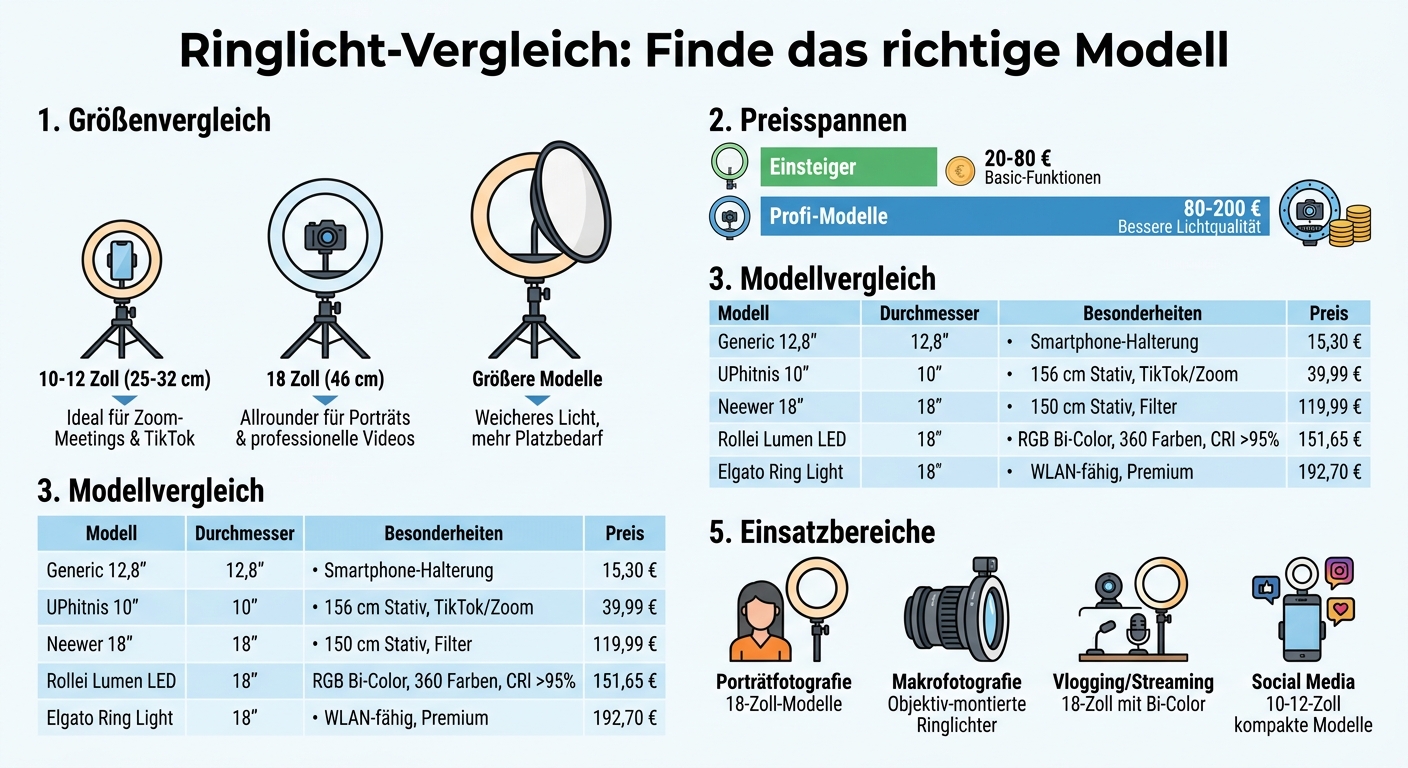
Ring light buying guide: sizes, prices, and areas of application in comparison
Choosing the right ring light depends on three main criteria: size, brightness, and compatibility. Here's what you should pay attention to for these points to find the ideal model for your requirements.
Size and Diameter
The diameter of a ring light affects both light distribution and application area. An 18-inch ring light (approx. 46 cm) is a true all-rounder. It provides enough light for portraits, product photography, and professional videos. Smaller models with a diameter of 10 to 12.8 inches (25–32 cm) are excellent for Zoom meetings, TikTok clips, or other desktop recordings. Generally, the larger the ring light, the softer and more even the light – however, this also increases the space requirement and weight.
Brightness, Lumens, and Color Temperature
For an 18-inch ring light, 45 to 90 watts are optimal. A dimming function is a must so you can flexibly adjust the brightness and avoid overexposure. If you want flexibility in color temperature, you should choose a bi-color model. These offer settings from warm light (approx. 3,200 K) to cool daylight (5,600 K or more). For color-accurate shots, a color rendering index (CRI) of over 95% is important. Models like the Rollei Lumen LED meet this high standard.
Compatibility and Accessories
A good ring light allows you to securely attach your camera or smartphone in the center – this creates the typical halo effect with striking reflections in the eyes. Make sure that the included tripod has the appropriate height for your intended use. For standing portraits, you need a taller tripod than for desktop shots. Remote controls are a practical extra for adjusting brightness and color temperature during recording. Models like the Elgato Ring Light (€192.70) even offer Wi-Fi functions that integrate perfectly into streaming setups.
Comparison of selection criteria
| Model | Diameter | Special features | Price (approx.) |
|---|---|---|---|
| Rollei Lumen LED | 18" | RGB Bi-Color, 360 colors, CRI >95 % | €151.65 |
| Neewer 18" | 18" | 150 cm tripod, white/orange filter | €119.99 |
| Elgato Ring Light | 18" | Wi-Fi enabled, premium craftsmanship | €192.70 |
| UPhitnis 10" | 10" | 156 cm tripod, ideal for TikTok/Zoom | €39.99 |
| Generic 12.8" | 12.8" | Smartphone holder included | €15.30 |
The table gives you an overview of different models and their features. If you want to achieve professional results, you should invest at least €80. For glasses wearers, a tiltable tripod is particularly helpful, as it minimizes reflections when the light is positioned slightly above eye level. With the right ring light, you can achieve impressive results in portrait and macro photography.
Popular Ring Light Models
Here we present three ring light models that cover different requirements. The German market offers a variety of options – from special macro lights to versatile studio solutions. The following overview will help you get a quick overview of three selected models.
BRESSER STR-48B Bi-Color LED Ring Light
The BRESSER STR-48B is a bi-color ring light that stands out with its flexible color temperature setting. With a range from 3,200 K (warm white) to 5,600 K (daylight), you can precisely adjust the lighting to your needs. With a diameter of 48 cm, it is versatile, whether for portrait shots or product photography. Thanks to the stepless dimming function, you can set the brightness exactly and avoid overexposure. This model is particularly suitable for photographers who value even illumination and natural skin tones.
Dörr LED Ring Light Ultra 60
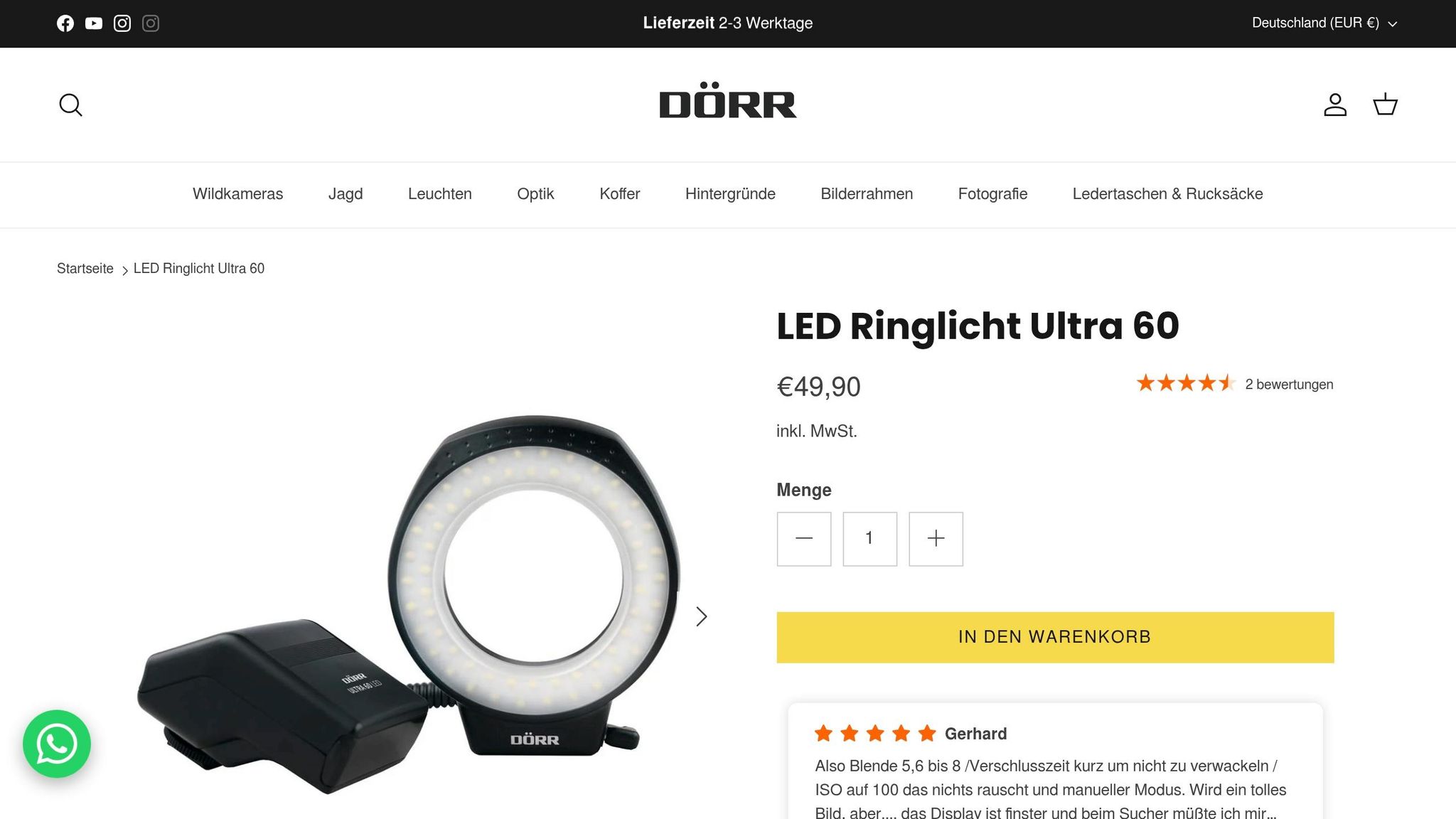
The Dörr Ultra 60 is specifically designed for macro and close-up photography and attaches directly to the lens. It features 60 LEDs and a color rendering index of over 95, ensuring precise and natural colors – ideal for technical shots such as circuit boards, coins, or medical images. Adapter rings for filter threads from 52 to 72 mm are included, and the separate control unit is mounted on the camera's hot shoe. The color temperature of 5,800 K corresponds to daylight. At €49.90, this compact model, powered by four AA batteries, is perfect for shots in the range of 3 to 100 cm. Users rate it 4.5 out of 5 stars.
Piecarté Ring Light Options
Piecarté offers a wide range of ring lights, from small selfie lights (approx. 25 cm) to large professional ring lights (45–55 cm). The larger models are ideal for full-body shots and create the characteristic circular light reflection in the eyes. Many sets include a 2-meter tripod, smartphone holders, and remote controls. Particularly interesting are the RGB models, which enable dynamic effects such as pulse or color change – perfect for creative TikTok and YouTube videos. With high customer satisfaction, Piecarté has made a name for itself in Germany.
Setup and Usage Tips
Position your ring light directly in front of you to minimize shadows and evenly illuminate your subject. This arrangement ensures that skin imperfections are less noticeable and creates a smooth, flawless look – perfect for beauty shots or vlogs where a professional appearance is desired.
If you want to add more depth to your image, try placing the ring light slightly to the side. This creates soft shadows that give your face more dimension and make it appear more natural. Experiment with different angles to find out which position works best and adds extra accents.
Adjust the brightness of the ring light to suit the situation: for a cozy atmosphere, choose a lower brightness, while for detailed content, a higher setting is ideal. Also, use the option to change the color temperature – warmer tones are suitable for indoor shots, cooler ones for daylight. This way, you achieve a harmonious light balance that perfectly adapts to the environment.
The ring light can also be combined with natural light. Position yourself near a window and use the ring light to lighten shadows. This mix of natural and artificial light creates a harmonious and dynamic lighting result.
Experiment with the different settings and positions to find the perfect "sweet spot." Each application requires an individual approach to get the best out of your subject. With these tips, you can optimally adjust the lighting and achieve impressive results.
Ring Light Applications
After the technical explanation and setup tips, let's look at how ring lights can be effectively used in various areas of photography and videography.
Portrait Photography
Ring lights provide even, shadow-free illumination – perfect for beauty and business portraits. A special effect is the round catchlights in the eyes, which give the images a professional touch.
When the ring light is positioned frontally, shadows almost completely disappear. A slightly sideways placement, however, can create soft shadows that give the face more depth and naturalness. In studios, a ring light is often used as an additional fill light to subtly reduce shadows without dominating the main light source.
Macro Photography
In macro photography, where the lens is close to the subject, the camera often blocks ambient light. A ring light attached to the lens solves this problem by illuminating the subject directly and evenly. This allows for precise capture of details such as wood grain, fabric textures, or technical intricacies.
LED ring lights have the advantage that you can see how the light falls before shooting. This facilitates both manual and automatic focusing. For optimal results, the subject should be about 10 to 20 cm away from the ring light. However, with reflective surfaces, individual LEDs can create distracting reflections, so caution is advised.
In addition to detail accuracy in macro photography, ring lights are also excellent for dynamic content.
Vlogging and Content Creation
Ring lights are popular with vloggers and content creators because they provide shadow-free illumination directly around the camera lens. The circular catchlights in the eyes give videos and photos a vibrant look. Models with a color rendering index (CRI) of 90 or higher guarantee natural skin tones and precise color reproduction.
For optimal results, the ring light should be positioned at eye level, approximately 30–60 cm in front of the face, tilted slightly downwards to avoid shadows under the chin. Smaller ring lights with a diameter of 25 to 30 cm are well-suited for close-ups or video calls. Larger models with a diameter of 35 to 45 cm are ideal for wider shots, such as YouTube videos. Professional models often offer the ability to adjust the color temperature between 2,900 K (warm) and 7,000 K (cool) to create different moods.
Conclusion
Ring lights are a decisive factor for professional photo and video shoots. They ensure even, shadow-free illumination and create the typical light reflections in the eyes that look particularly impressive in portraits and close-ups. Choosing the right model – tailored to size, brightness, and color temperature – can significantly improve the quality of your shots.
“The right ring light reduces post-processing time by 40% through consistent exposure." – Karl Taylor, Lighting Specialist
In Germany, 65% of YouTubers use ring lights to optimize their video quality. A Berlin vlogger reported that he was able to increase his subscriber count by 40% after using a high-quality ring light. This example shows how important proper lighting is for good content.
Whether it's portrait photography, macro shots, or vlogging – with the right ring light, you can perfectly stage your subject. Piecarté offers a wide selection of ring lights, from the 46cm ring light with tripod to modern RGB models. With an instruction manual, a 2-year warranty, and fast shipping within Germany, you receive high-quality products specifically tailored to your needs. Visit piecarte.com to view current prices and reviews.
A tip from professionals: Place the ring light at eye level, at a distance of about 1.5 m, and use a color temperature of 5,500 K to create a natural daylight feel. With Piecarté and the 30-day return guarantee, you are perfectly equipped to achieve professional results!
FAQs
Do I need an LED ring light or a ring flash for my camera?
Ring flashes and LED ring lights have very different applications. A ring flash delivers short, intense light pulses that are perfect for shadow-free close-ups – ideal for macro or portrait photography.
In contrast, LED ring lights emit continuous light. This makes them particularly suitable for video recordings, live streams, or product photography.
In short: If you need short light flashes, go for a ring flash. For continuous lighting, an LED ring light is the better choice.
How big should a ring light be for my shots?
The choice of ring light size depends on what you want to use it for and how far it is from the camera. For selfies, close-ups, or video calls, smaller models with a diameter of 10–14 inches (about 26–36 cm) are ideal. They are space-saving and easy to handle. If you are planning a professional studio setup or want to illuminate larger areas, you should opt for a larger ring light with 18–22 inches. These offer even illumination even at greater distances.
What should I really pay attention to regarding CRI, Kelvin, and wattage?
When it comes to lighting, three values play a crucial role: CRI, Kelvin, and Lumen. Here's a quick overview of what to look for:
- CRI (Color Rendering Index): For realistic and natural color reproduction, the CRI value should be at least 90. Values of 95 or higher are even better, as they reproduce colors particularly precisely.
- Kelvin (Color Temperature): Daylight-like light is in the range of 5500 to 6000 Kelvin. This color temperature provides neutral and clear lighting, ideal for video recordings or photography.
- Lumen (Brightness): For sufficient light output, you should aim for at least 1000 lumens. This ensures optimal brightness, especially in video recordings where well-lit scenes are crucial.
With these values, you ensure that your lighting is both technically and aesthetically impressive.

LED ring lights are an ideal light source for even illumination and shadow-free shots. Whether for portraits, make-up tutorials, YouTube videos or video conferences – they significantly improve light quality and are energy-efficient. With adjustable brightness, color temperature, and often RGB options, they offer versatile applications. Models are available in various sizes, from compact 26 cm to professional 56 cm. Important factors when buying: diameter, brightness, color temperature, and accessories such as tripods or remote controls.
Key advantages at a glance:
- Even, shadow-free light
- Energy-efficient and long-lasting (often up to 50,000 hours)
- Adjustable brightness and color temperature
- Various sizes for different applications
Recommended sizes:
- 25–32 cm: Perfect for Zoom meetings or vlogging
- 45–56 cm: Optimal for make-up tutorials, portraits, or studio shots
Comparison of Piecarté models:
| Model | Diameter | Target Group | Special Feature |
|---|---|---|---|
| LED Ring Light with Tripod | 30 cm | Beginners, Vloggers | Tripod, remote control |
| RGB Ring Light without Tripod | 36 cm | Streamers, Gamers | Creative color control, no tripod |
| Tricolor LED Ring Light | 46 cm | Semi-pros, YouTubers | Three color temperatures, full-body shots |
| Professional LED Ring Light | 56 cm | Pros, Studios | Maximum brightness, studio quality |
Choose the right model for your needs and improve your shots with an LED ring light.
Ring Light Tutorial | 3 Popular Ring Lights Compared for Filmmakers
sbb-itb-d7de319
The Most Important Advantages of LED Ring Lights
Here we take a look at the central advantages of LED ring lights and why they have become established in many areas.
Better Light Quality
LED ring lights produce even, shadow-free light. The special feature: the light hits the subject from all sides simultaneously. This virtually eliminates unsightly shadows – for example, under the eyes or on the nose. This is a real plus, especially for portraits or beauty tutorials.
High-quality models achieve a CRI value of 95 or more. This means colors appear almost as they do in reality, which is particularly important for make-up shots or product photos. Unlike flash, LED ring lights provide continuous light. This means you can see exactly how the light falls on your subject before you shoot. This consistent light quality opens up many creative possibilities.
Versatile Use
Whether portraits, make-up tutorials, YouTube videos, live streams or video conferences – LED ring lights are true all-rounders. Especially in the home office, they ensure that you look professional in Zoom meetings or on Twitch even in poor lighting conditions.
“A ring light helps you look your best by eliminating unflattering shadows and providing even light." – Rio Beauty
Another advantage is the so-called catchlight effect. This circular light reflection in the eyes can increase viewer engagement in video tutorials by up to 30%. This makes a ring light not just a light source, but a real tool for content producers.
In addition to image quality, LED ring lights also score with their economic advantages.
Energy Efficiency and Long Lifespan
LED ring lights consume significantly less energy than conventional halogen or incandescent lamps and generate hardly any heat. With a typical power consumption of 10 to 12 watts and a lifespan of up to 50,000 hours – which corresponds to approximately 17 years at 8 hours of use per day – they are extremely efficient and durable.
| Lamp Type | Average Operating Hours | Failure Mode |
|---|---|---|
| LED Ring Light | 25,000 – 50,000+ hours | Gradual dimming |
| Compact Fluorescent Lamp (CFL) | 8,000 – 10,000 hours | Sudden failure |
| Halogen | 2,000 – 4,000 hours | Sudden failure |
| Incandescent Lamp | approx. 1,000 hours | Sudden failure |
With their long lifespan and low power consumption, LED ring lights are not only a practical, but also a cost-saving choice.
What to Consider When Buying an LED Ring Light
Before buying an LED ring light, you should consider some important criteria. Especially if you want to achieve professional results, these points can make all the difference. The choice of the right model strongly depends on what you want to use the ring light for.
Size and Diameter
The size of a ring light affects both the illuminated area and portability. Here's an overview of which size is suitable for which purpose:
| Application | Recommended Diameter | Advantage |
|---|---|---|
| Professional Photography/Video | 45–55 cm | Wide illumination, ideal for full-body shots |
| Make-up & Beauty | approx. 45 cm | Even light for precise detail work |
| YouTube / Streaming | 30–45 cm | Good balance between size and handling |
| TikTok / Vlogging | 25–32 cm | Compact and easily mountable on small tripods |
| Zoom / Video Calls | approx. 25 cm | Sufficient for clear face illumination |
For use at a desk or in a home office, models with a diameter of 25 to 32 cm are sufficient. If you produce make-up tutorials or professional portraits, you should opt for a larger model from 45 cm upwards. The ability to adjust the brightness also plays an important role.
Brightness and Dimming Function
A steplessly dimmable ring light is particularly practical, as it allows you to adjust the brightness precisely to your needs. This minimizes the risk of overexposure – especially during longer live streams or recordings. Stable and consistent light intensity is crucial here.
Color Temperature and RGB Options
Most ring lights offer three color modes: warm white (approx. 2,700–3,200 K), neutral white, and cool white (approx. 5,500–6,500 K). Warm white creates a cozy atmosphere and is well suited for indoor shots. Cool white, on the other hand, resembles daylight and is ideal for make-up work or product photography. Make sure to adjust the color temperature to the ambient light to avoid unwanted color contrasts.
Models with RGB options offer additional possibilities for creative color effects. These are particularly popular with streamers and content creators on platforms like TikTok or Instagram.
Power Supply and Mobility
The type of power supply can be crucial depending on the application area:
- AC adapter: Perfect for stationary setups in the studio or home office, as they ensure a stable power supply.
- USB connection: Flexible to use via laptop, power supply unit, or power bank – ideal for mobile use.
- Battery operation: The most mobile option, but often with limited runtime and reduced brightness.
If you primarily work at a fixed location, a mains-powered model is the best choice.
Included Accessories
It's worth checking the scope of delivery. Practical accessories such as a sturdy tripod, a smartphone holder or a remote control make your work easier – especially if you are filming alone. Additional features such as ball heads or camera mounts offer you more flexibility in aligning the light.
LED Ring Lights at Piecarté
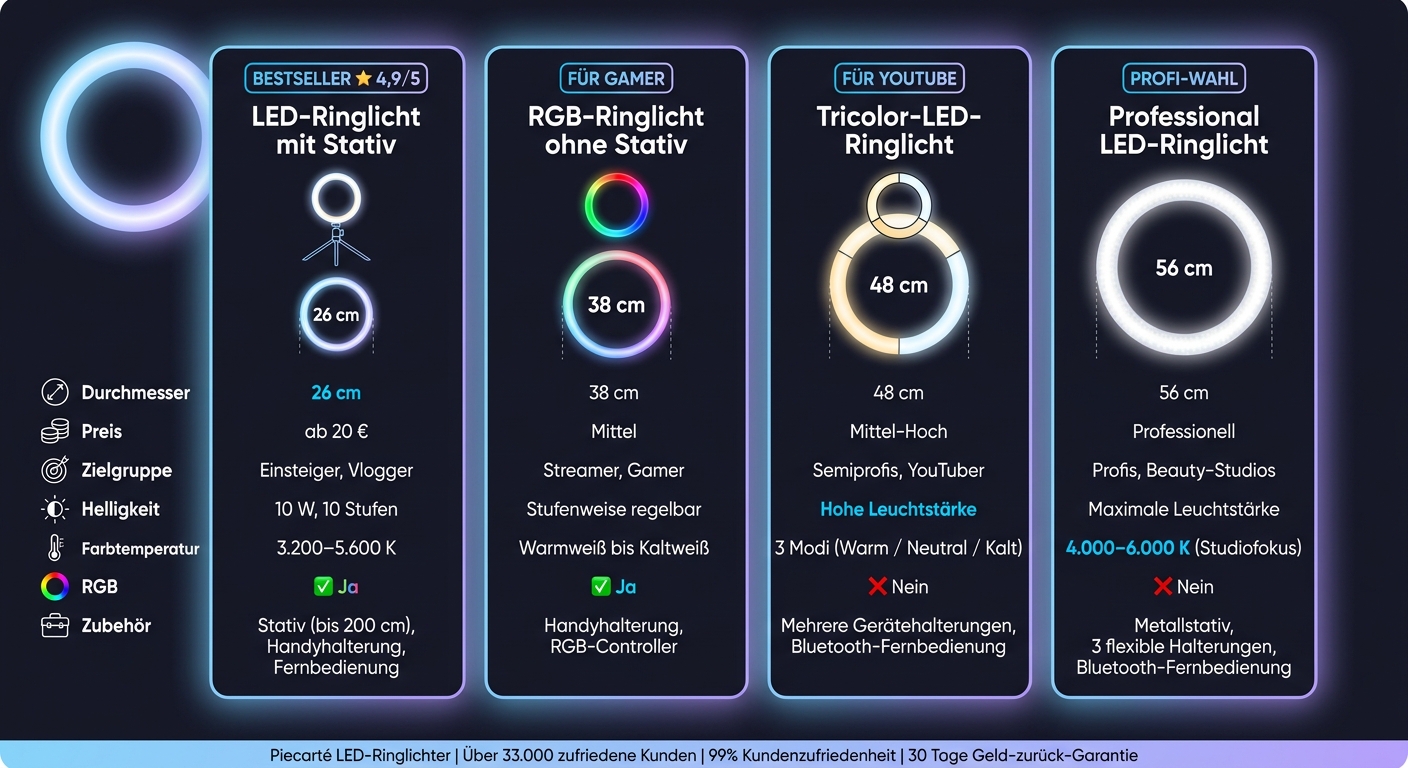
LED Ring Light Comparison: All Piecarté Models at a Glance
Piecarté offers four different LED ring light sizes, tailored to different needs and applications – from beginners to professionals. Here you will find a brief overview of the models and a comparison table to help you with your selection.
26 cm RGB Ring Light with Tripod
The compact 26cm model impresses with 20 static colors, dynamic RGB modes, adjustable color temperature (CCT mode) and stepless brightness control. Perfectly suited for TikTok, YouTube, Zoom meetings or product photography. The scope of delivery includes a height-adjustable tripod, a smartphone holder and a remote control.
“The combination of RGB effects and neutral light makes it much more versatile than normal ring lights. The tripod can be extended to a comfortable height and feels stable." – Carina, verified buyer, Piecarté
With a rating of 4.9 out of 5 stars (based on 20 reviews), this model is a favorite. The only criticism: some users would have liked stepless brightness control.
36 cm RGB Ring Light without Tripod
The 36cm model is aimed at streamers, gamers and content creators who value individual backlighting. The flexible RGB control enables creative color adjustments that are particularly useful for building a brand identity. Since no tripod is included, this model is ideal as an addition to existing equipment.
46 cm Tricolor LED Ring Light
The 46cm ring light is designed for semi-professional applications. Due to its larger diameter, it offers even illumination that is also suitable for full-body shots. With the tricolor mode, you can switch between warm white, neutral white and cool white, which is practical in different lighting situations. Particularly popular for make-up tutorials, portrait photography and YouTube videos.
56 cm Professional LED Ring Light
The largest model in the range is the 56cm ring light, which was developed for professional applications. It offers maximum light coverage and provides shadow-free studio lighting. The robust tripod is designed for long periods of use, and the simple plug-and-play setup makes it particularly user-friendly. Ideal for professional content creators, beauty studios and demanding streamers.
Comparison Table: LED Ring Lights at Piecarté
Here you will find a compact overview of the most important features of the LED ring lights. It complements the detailed descriptions from the previous section and helps you quickly find the right model for photography, videos or content creation.
| Model | Diameter | Price | Brightness | Color Temperature | RGB | Accessories |
|---|---|---|---|---|---|---|
| RGB Ring Light with Tripod | 26 cm | from €40 | 10 W, 10 levels | 3,000–6,000 K | Yes | Tripod (up to 200 cm), smartphone holder |
| RGB Ring Light without Tripod | 36 cm | from €60 | Steplessly adjustable | Warm white to cool white | Yes | Smartphone holder, RGB modes |
| Tricolor LED Ring Light | 46 cm | from €109 | High luminosity | 3 modes (warm/neutral/cool) | No | Multiple device holders, Bluetooth remote control |
| Professional LED Ring Light | 56 cm | from €129 | Maximum luminosity | Studio focus (2,700–6,500 K) | No | Metal tripod, 3 flexible holders, Bluetooth remote control |
A few highlights from the table:
- The 26cm model is particularly practical if you are looking for an affordable entry-level model. It offers RGB lighting effects and a complete tripod set – all for around €40.
- For users who already own a tripod, the 36cm model might be interesting. It also offers RGB functions but comes without a tripod.
- If you value skin-flattering light for portraits or make-up shots, the 56cm professional model is ideal. With a color temperature of 2,700 to 6,500 K, it delivers studio-quality light.
“The higher the light temperature in Kelvin, the bluer and colder the light appears." – Piecarté
Another plus point of the 56cm model: It has three flexible holders, allowing you to use multiple cameras or smartphones simultaneously. Perfect for more complex productions.
With this table, you have all the important information at a glance to choose the right LED ring light for your requirements.
Tips for Choosing and Using an LED Ring Light
Now that you know the technical details and models, these tips will help you choose the right ring light and use it effectively.
Align Budget and Purpose
Before buying, consider exactly what you want to use the ring light for. For video calls or occasional selfies, a simple model is often sufficient. If you want to regularly create content such as vlogs, make-up tutorials, or TikTok videos, a mid-range device is worthwhile. For professional applications such as portrait or product photography, you should consider a high-quality, studio-appropriate model. Once you have defined your purpose, you can also plan the ideal positioning of the light.
Finding the Right Setup and Angle
Place your camera or smartphone in the center of the ring to create the typical halo effect and minimize shadows. If you want more depth or a more dramatic look, you can position the light at a 45-degree angle to the side. If you wear glasses, it helps to place the ring light slightly higher and tilted downwards to avoid distracting reflections. Once the setup is correct, you can focus on optimally adjusting the brightness and color temperature.
Adjusting Brightness and Color Temperature
Gradually increase the brightness until you achieve the desired result. A good starting point for color temperature is 5,500 K:
"When choosing a new light, try to find one as close to 5500K as possible. This is the most neutral light temperature, which will give off white light rather than blue or yellow-tinted light." – Replica Surfaces
For portrait shots, warmer tones around 4,200 K can be particularly flattering. If the light seems too intense, you can use a thin, white fabric as a diffuser to soften it. With these adjustments, you'll get the most out of your ring light and create optimal conditions for your shots.
Conclusion
LED ring lights provide even, shadow-free illumination and significantly enhance photos and videos. They are versatile – from simple selfies to professional portrait photography – and impress with low energy consumption and a long lifespan.
Piecarté offers the right model for every budget and every demand: from the compact 26cm ring light for beginners to the 56cm professional model for studio shots. With over 33,000 satisfied customers, an impressive customer satisfaction rate of 99%, and free delivery within 2–3 working days, there are many reasons to choose Piecarté. Details on individual models can be found in the comparison table above.
If you have any further questions, our German-speaking customer support will be happy to help – you can reach us at info@piecarte.com. Thanks to the 30-day money-back guarantee and the 2-year statutory warranty, you can try your purchase without risk.
Find your perfect ring light at Piecarté now and take your shots to a new level!
FAQs
How far should an LED ring light be from the face?
An LED ring light should be positioned to illuminate the face evenly. The distance varies depending on the model and desired result. Usually, the ideal distance is between 30 and 60 centimeters to achieve balanced and pleasant lighting.
Which CRI value is really important for natural skin tones?
A CRI value of 90 or higher is important for natural-looking skin tones. It ensures that colors are reproduced realistically and skin tones appear authentic.
Why does my ring light flicker in video and what can I do?
The flickering of ring lights can have various technical causes, often related to LED quality, power supply, or the use of a dimmer. Here are some tips to get the problem under control:
- Check power grid: Voltage fluctuations in the power grid can cause flickering. Make sure your power connection is stable.
- Check dimmer suitability: Not all ring lights are designed for operation with a dimmer. If your light flickers, deactivate the dimmer or ensure that the ring light is dimmable.
- Quality of the ring light: Cheap models may contain inferior LEDs that are more prone to flickering. Invest in a high-quality ring light to avoid such problems.
With these measures, you ensure even illumination that is perfect for videos and photos.

A ring light provides even, shadow-free illumination – ideal for makeup, photography, and beauty applications. The circular light source minimizes shadows, making skin appear smoother and colors more natural. Modern LED models offer adjustable color temperatures (3,000–5,600 K) and are more energy-efficient than older fluorescent versions. For makeup artists and photographers, a high CRI (over 95) is crucial for accurate color reproduction. Portable, battery-operated models make ring lights practical for mobile use.
Highlights:
- Advantages: Shadow-free lighting, natural color reproduction, vivid eye reflections.
- Areas of application: Make-up, eyelash extensions, nail design, before-and-after photos.
- Technical details: Color temperature 3,000–6,500 K, CRI value 95+, dimmable brightness.
- Price range: €16.50 to €268.00, depending on size and features.
Whether at home or in the studio – a ring light improves light quality and ensures professional results.
Neewer Ring Light Set | Unpacking & testing
sbb-itb-d7de319
Why Make-up Artists Need Ring Lights
For makeup artists, even, shadow-free lighting is essential. Conventional ceiling lights often cast harsh shadows that make the precise application of foundation, contour, or blush difficult. Ring lights, on the other hand, with their circular design, eliminate these shadows and ensure even illumination. Models with a Color Rendering Index (CRI) above 95 are particularly ideal, as they reproduce colors true to life — a crucial advantage when selecting foundation or eyeshadow shades. This results in more precise makeup application and a more professional finish.
"The circular light ring design provides even illumination, eliminating shadows and ensuring that all areas of the [face] are evenly lit." – Seming Lighting
Shadow-free lighting for precise makeup application
The perfect color temperature for makeup lies between 4,800 K and 6,000 K. Within this range, skin appears neither too cool nor too warm, and details remain clearly visible. Yellow light should be avoided, as it can lead to an overapplication of concealer. Neon lights, on the other hand, make skin appear pale and encourage the use of too much foundation.
Positioning tip: Place the ring light 45–60 cm from your face and slightly above eye level, with a slight downward tilt. For self-application, it is recommended to place a mirror centrally within the ring light. This ensures even illumination of the face.
Portable solutions for mobile makeup artists
Mobile makeup artists often face the challenge of working in locations with poor or uneven lighting – be it hotel rooms or wedding venues. Portable ring lights with flexible power options such as USB charging, integrated rechargeable batteries, or external lithium-ion batteries offer a practical solution.
Some models weigh as little as 131 g and fit easily into any work bag. Foldable, height-adjustable stands also allow for use on a wide variety of work surfaces, from low vanity tables to improvised workstations. This ensures optimal lighting at all times – no matter where you're working.
"Even amateurs can present themselves as professionals with one simple addition to their inventory; the ring light." – ETOILE
Color temperature guide for makeup and photography
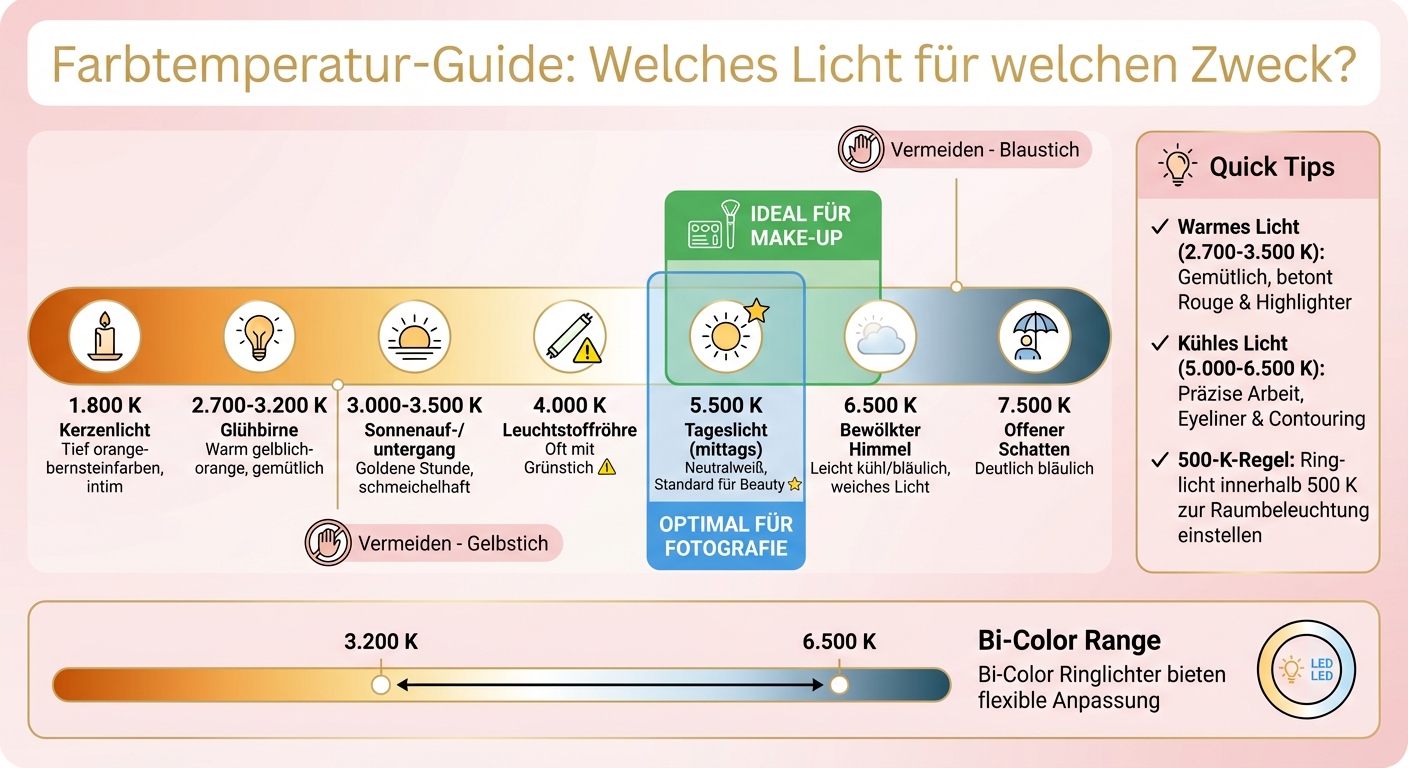
Color temperature guide for makeup and photography: Kelvin values compared
Color temperature, measured in Kelvin (K), influences whether light appears warm (yellowish-orange) or cool (bluish-white). This value is crucial for realistically representing skin tones and makeup colors both in the mirror and in photographs. Light with low Kelvin values (e.g., 2,700 K) creates a warm atmosphere, while higher values above 6,500 K provide cooler, daylight-like light.
The problem? Inappropriate color temperatures can distort skin tones. Light below 3,000 K often makes skin appear yellowish, which makes choosing the right foundation difficult. Light above 6,500 K, on the other hand, can make skin appear pale or even bluish – the result often looks unnatural. The ideal range lies between 5,000 and 5,500 K, as it simulates daylight and accurately reproduces colors.
"Lighting isn't just about brightness - it's about accuracy. A mismatched color temperature can make someone look tired, unhealthy, or artificially edited." – Jordan Lee, Professional Lighting Technician & Video Producer
Warm vs. cool light: What makes the difference?
- Warm light (2,700–3,500 K): It creates a cozy atmosphere and emphasizes warm skin tones, blush, and highlighter. Perfect for evening looks, but if used too much, it can make the skin appear yellow-toned.
- Cool light (5,000–6,500 K): This light is ideal for precise work such as eyeliner or contouring. However, warm tones can appear washed out and the skin can look dull.
Here is an overview of typical light sources and their color temperatures:
| Light source | Kelvin temperature (K) | Visual effect |
|---|---|---|
| Candlelight | ~1,800 K | Deep orange-amber; intimate |
| Light bulb (tungsten) | ~2,700–3,200 K | Warm yellowish-orange; cozy |
| Sunrise/Sunset | ~3,000–3,500 K | Golden hour; flattering |
| Fluorescent tube | ~4,000 K | Often with a greenish tint |
| Daylight (at midday) | ~5,500 K | Neutral white; standard for beauty |
| Cloudy sky | ~6,500 K | Slightly cool/bluish; soft light |
| Open shadow | ~7,500 K | Distinctly bluish |
Tip: Avoid applying makeup under extremely warm light (below 3,000 K), as this can distort skin tone. For evening events, it's recommended to test the finished makeup under approximately 3,000 K to ensure it looks good in the target lighting.
Adjustable Bi-Color Ring Lights
With this knowledge, you can make the most of the flexibility of bi-color ring lights. These lights (3,200–6,500 K) allow you to adapt the lighting to different environments and avoid problems with "mixed light" — for example, when cool daylight meets warm indoor light. High-quality models offer a CRI of 97+ and a TLCI of 98+, guaranteeing a true-to-life rendering of skin tones and makeup colors.
The 500K rule is a practical guide: Adjust your ring light to within 500K of the main light source in the room to avoid color casts. For most skin tones, a range of 5,000–5,600K is optimal.
"When you do your makeup in balanced, white light, you see every color value of everything at its truest." – Sophia Porter, Professional Makeup Artist
Ring lights for eyelash extensions and nail design
For intricate work such as eyelash extensions or nail design, proper lighting is essential. It not only ensures greater precision but also enhances the quality of the results. While color temperature is the focus when applying makeup, shadow-free visibility and accurate color rendering are particularly important here. The right light quality is therefore a crucial factor for achieving perfect detail work.
Optimal visibility for precise work
A ring light produces an even, soft light that minimizes shadows – perfect for seeing individual natural eyelashes and precisely applying extensions. Shadow-free light also prevents uneven lines and helps achieve symmetry in techniques like permanent makeup or microblading.
"Poor color rendering makes it harder to choose and match pigments." – CosmoGlo
Another advantage: dimmable functions. With brightness settings from 1% to 100%, you can adjust the light to each stage of your work. This not only protects your eyes but also increases comfort during longer sessions. High-quality models boast up to 2,700 lumens and a wide color temperature range from 3,200 K to 6,500 K.
True-to-life colors thanks to a high CRI
A high CRI (Color Rendering Index) is crucial for reliably assessing colors and pigments. For work such as nail design or cosmetic tattooing, a CRI of over 90 is recommended, ideally in the range of 95 to 97+. This ensures true-to-life color reproduction.
In addition, high-quality ring lights offer stable construction – for example, with a heavy steel base or a robust aluminum tripod – as well as flexible 360° swivel arms that allow for wobble-free work. This difference can be crucial, especially when choosing eyelash or nail polish colors.
Properly lighting before-and-after photos
Before-and-after photos are a real calling card for makeup artists and beauty professionals. To ensure your work looks its best in the photos, the right lighting is crucial. Just like in a beauty salon, even, shadow-free lighting is essential.
Ring light positioning for optimal results
To illuminate the face evenly and minimize shadows, the camera should be positioned centrally within the ring light. The light itself should be placed at eye level or slightly above and tilted slightly downwards – this will create as few shadows as possible.
The ideal distance between the ring light and the face should be between 45 and 90 cm. If the light is too close, details can appear washed out; if it's too far away, the light intensity decreases. For comparison photos, it's important to use the same position, brightness, and color temperature for both shots. A slight tilt of the light helps to avoid reflections for people wearing glasses. Also, the person shouldn't stand too close to the wall to avoid distracting shadows.
Ring lights compared to other light sources
Unlike daylight, a ring light offers consistent and adjustable illumination. Daylight is often unpredictable – its color temperature changes depending on the time of day and weather, and direct sunlight can create harsh shadows. Softboxes, on the other hand, provide softer, more directional light that shapes the face and creates shadows. Ring lights, however, ensure even illumination that conceals blemishes and highlights details.
Studio vs. Home: Choose your setup
Choosing the right ring light depends largely on whether you intend to use it in a professional beauty salon or at home. Salons often use larger ring lights with a diameter of approximately 45 cm (18 inches). These offer a wider light field and more even illumination. They are usually mounted on sturdy stands (up to 10 kg) or on walls or ceilings to save space and protect sensitive equipment. Such studio models achieve an impressive brightness of up to 5,000 lux at a distance of 0.5 meters and have an adjustable color temperature range between 2,900 K and 7,000 K.
For home use, more compact models with a diameter of 12–30 cm (5–12 inches) are suitable. These can be attached using desk clamps or lightweight table stands to save space. Home models cost between €16.50 and €23.00, while professional sets range from €76.00 to €268.00. Studios almost always prefer mains-powered models, as these guarantee consistent performance even during longer sessions. These differences will help you choose the right ring light for your specific needs. Below you will find more information about the optimal equipment for studios and home use.
Equipment for professional studios
As mentioned earlier, high color fidelity is crucial. A CRI of at least 95 or a TLCI of 98 is essential. Many professional ring lights also feature digital displays that allow for precise adjustment of brightness and color temperature. For applications like eyelash extensions, flexibly adjustable swivel arms can be helpful to avoid shadows from any angle.
Ring light setup for home
For your home setup, a medium-sized ring light with adjustable brightness and color temperature is usually sufficient. A simple mounting option, such as a desk clamp, is ideal. Even at home, proper positioning is crucial for optimal results. If the light appears too intense in smaller rooms, you can soften it with a diffuser or increase the distance to create softer shadows. Many models for home use also offer integrated smartphone holders, which is particularly useful when filming makeup tutorials or taking photos. At Piecarté, you'll find a selection of ring lights that can be perfectly adapted to your needs.
What you should consider when buying a ring light
Once you've decided where you want to use your ring light – whether in the studio or at home – the technical details become important. Size and diameter are particularly crucial, as they significantly impact the light quality. Larger ring lights (around 35 to 45 cm) produce softer, more even light and considerably minimize harsh shadows.
"A good ring light for makeup will provide you with clear, soft, and consistent lighting that can accurately match foundation shades." – Daniel Wright, Neewer
Compact models are practical for the desk or on the go, but often produce a more intense and harsher light.
Another factor is color temperature. A range of 3,000 K to 6,500 K is optimal, with daylight (around 5,500 K) considered ideal. Also, pay attention to the CRI (Color Rendering Index): a value of at least 90 is recommended, while professional models often achieve values of 97 or higher.
When it comes to power supply, you have several options: USB models are ideal for on the go, mains power ensures consistent performance in the studio, and battery operation offers maximum flexibility. A dimming function is also important for stepless brightness adjustment. High-quality models offer flicker-free dimming, which is more comfortable for the eyes during extended use. Accessories such as height-adjustable tripods, smartphone holders, or ball-head mounts for cameras can also be crucial.
Key features and specifications
The diameter of your ring light greatly influences the light quality and its range of applications. An 18-inch (approximately 45 cm) model offers a good compromise between portability and professional light coverage. Larger ring lights also allow for greater distance from the model, resulting in less heat buildup and more comfortable light for the eyes.
LED ring lights are particularly energy-efficient and generate very little heat, making them ideal for extended use. An often overlooked factor is the R9 value, which is especially important for vibrant reds. A high R9 value is crucial for beauty applications to ensure authentic color reproduction on camera. Furthermore, the light should be flicker-free to avoid distracting effects during video recordings and to protect the eyes.
These aspects are relevant for both professional use in beauty salons and mobile applications, and will help you find the right ring light for your needs.
Product comparison table
Here is an overview of some popular models and their features:
| Model | Diameter | Color temperature | CRI | Price |
|---|---|---|---|---|
| Compact (Entry-level) | 12–13 cm | 3,000 K–6,000 K | 97+ | approx. €29.99 |
| Medium (Semi-Pro) | 45 cm | 2,500 K–10,000 K | 97+ | approx. €169.99 |
| Professional studio | 45 cm | 2,900 K–7,000 K | 97+ | approx. €209.99 |
| XXL Studio | 50 cm | 3,200 K–5,600 K | N/A | approx. €199.99 |
Prices vary considerably depending on the features: entry-level models with smaller diameters start at around €29.99, while professional sets with larger diameters and more functions range from €169.99 to €209.99. At Piecarté, you'll find a carefully curated selection of ring lights to suit different needs and budgets.
How to use ring lights effectively
Setup and positioning tips
Proper positioning makes all the difference. The camera or smartphone should be placed directly in the center of the ring light. This is the only way to achieve the characteristic circular light reflection in the eyes and shadow-free photos. The ring light itself should be positioned at eye level to avoid unflattering shadows.
"If your camera lens isn't in the center of your ring light, you're using it incorrectly." – Allen Murabayashi
The distance between your face and the ring light should be between 45 and 90 cm. For makeup applications, about 60 cm is ideal. Do you wear glasses? Then tilt the light slightly downwards to minimize distracting reflections.
For studio-like results, you can use the ring light as the main light and additionally place softboxes to the sides to perfectly illuminate your face. If the light appears too intense, point it at a white wall to soften it. A little tip: When shooting under the ring light, use slightly bolder colors for lips and eyes, as cameras often render colors less intensely.
Besides proper positioning, you should also pay attention to maintenance to achieve consistently good results.
Care and maintenance
Modern LED ring lights generate very little heat, so you can safely store them immediately after use. Make sure to secure the ring light head firmly to the tripod and regularly check the cable connections to prevent electrical problems. A sturdy tripod or table clamp will prevent damage to the ring light.
Avoid leaving the light at maximum brightness for extended periods when people or animals are sitting directly in front of it – this can be uncomfortable. For bi-color ring lights with a daylight setting, you should manually set your camera's white balance to "daylight" to obtain natural colors.
These tips will keep your ring light in top condition and deliver consistently good results.
Conclusion
Ring lights are a must-have for beauty professionals and makeup enthusiasts. Their circular light source minimizes shadows, ensures even illumination, and creates the popular light reflection – perfect for precise work when applying makeup, eyelash extensions, or for impressive before-and-after photos.
A diameter of approximately 45 cm and an adjustable color temperature range between 3,000 K and 6,000 K offer an ideal balance between light quality and flexibility.
Piecarté ring lights meet these requirements and deliver outstanding results both in professional studios and at home. Battery-powered models give mobile makeup artists the freedom to work anywhere, while mains-powered versions ensure consistent performance during long sessions. Features such as integrated smartphone holders and mirrors make setup particularly easy for content creators and self-application. These thoughtful features underscore the benefits and applications described in this guide.
With the right settings, correct placement, and a little care, you can get the most out of your ring light. It's an investment that quickly pays for itself through professional results and versatile applications.
FAQs
Do I really need a ring light, or is daylight sufficient?
Daylight can be a good light source when it's even and stable. However, it's often unpredictable, as it depends on factors like the time of day, the weather, and the season. A ring light, on the other hand, provides controlled and even illumination that minimizes shadows, accurately reproduces colors, and highlights details. For makeup artists, photographers, and stylists, a ring light is therefore the perfect solution for achieving professional results regardless of external lighting conditions.
How do I avoid color casts in mixed lighting?
To avoid color casts, you should use neutral lighting. A color temperature between 5000K and 5500K is ideal, as it closely resembles natural daylight. Experiment with different light sources with varying color temperatures to find even lighting that reduces color distortion caused by light that is too warm or too cool.
Which ring light size is suitable for my setup?
The ideal size of a ring light depends on its intended use and the available space. For makeup application or beauty photography, ring lights with a diameter of 38 to 48 cm are particularly suitable. They provide even lighting and create the popular ring effect in the eyes.
- Small rooms: A ring light with a diameter of 38 cm is usually sufficient here. It provides enough light without taking up too much space.
- For larger studios or professional photos: For before-and-after pictures or larger scenes, models with a 46 to 48 cm diameter are the better choice. They cover larger areas and produce more intense light.
So before you buy, consider how much space you have and what level of illumination you need.